AI Visibility Share of Voice: How Home Service Businesses Can Win Higher LLM Rankings in 2026
Listen on your favourite platform
| Platform | Link |
|---|---|
| YouTube | Listen on YouTube → |
| Transistor | Listen on Transistor → |
| pod.link | Listen on pod.link → |
| Pocket Casts | Listen on Pocket Casts → |
| Podverse | Listen on Podverse → |
| Castro | Listen on Castro → |
| getpodcast | Listen on getpodcast → |
| Spotify | Listen on Spotify → |
| Amazon Music | Listen on Amazon Music → |
| Castbox | Listen on Castbox → |
| Podcast Addict | Listen on Podcast Addict → |
| Steno.fm | Listen on Steno.fm → |
What Does “AI Visibility Share of Voice: How Home Service Businesses Can Win Higher LLM Rankings in 2026” Talk About?
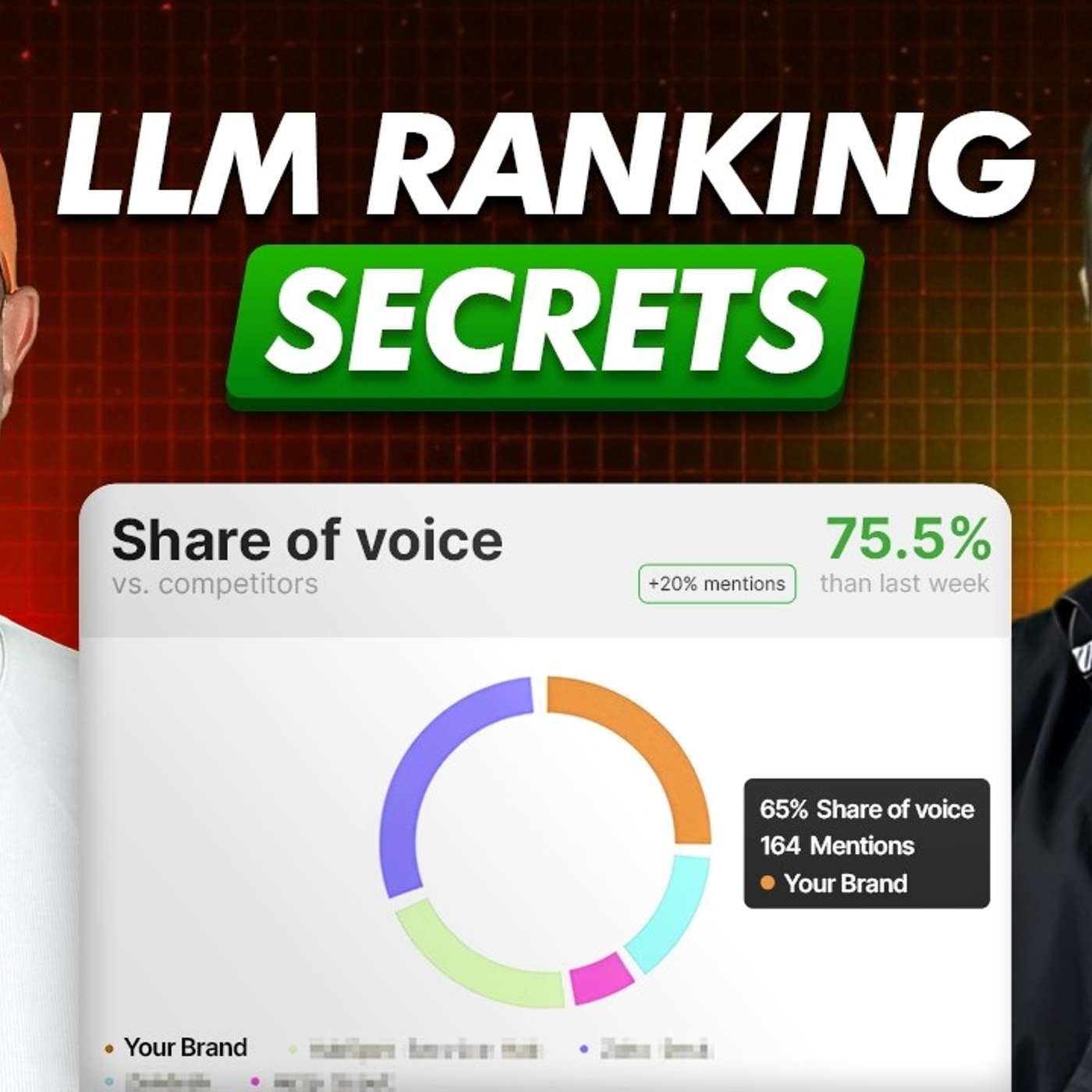
This episode of the Fatrank Podcast features James Dooley in conversation with Eldar Cohen, founder of Local Dominator, exploring how home service businesses can track and improve their AI visibility through a metric called Share of Voice. The discussion opens with a live walkthrough of the Share of Voice feature inside Local Dominator, showing how businesses can instantly see what percentage of AI-generated answers they appear in compared to their top five competitors. A score of 42% is highlighted as a strong result, while scores as low as 3% or 5% signal that a business is not being cited or mentioned in large language models at all.
The conversation moves into why Share of Voice is a more meaningful measurement than traditional keyword rank tracking. Eldar explains that AI engines like ChatGPT, Gemini, AI Mode, Perplexity, Claude, and Grok understand topics rather than individual keywords, making broad visibility far more important than ranking for specific search terms. James adds that LLMs use a process of query fan-out and grounded snippet synthesis, meaning businesses need to appear across a range of trusted sources that these models actually cite. The two also discuss how to use competitor data inside Local Dominator to identify which sources are being cited, then either earn placements on those sources or create similar content on rankable sites to build Share of Voice.
A key strategic point raised by Eldar is that home service businesses should prioritise their Share of Voice efforts by engine. He advises focusing first on Google AI Mode and Gemini, then ChatGPT, then Grok, and treating Perplexity and Claude as lower priorities since home service customers are far more likely to search through Google-integrated AI products. James reinforces this by sharing data from over 650 UK local industries, confirming that AI Overviews within Google are the most powerful channel, followed by AI Mode and then ChatGPT. The target Share of Voice benchmark Eldar recommends is 75% or higher to genuinely benefit from AI-driven traffic.
“You want to be somewhere at around 75% and up. This is where you are really enjoying the AI traffic.”
— Eldar Cohen
Who Are the Guests on “AI Visibility Share of Voice: How Home Service Businesses Can Win Higher LLM Rankings in 2026”?
James Dooley is a well-known figure in the SEO and digital marketing space, particularly recognised for his work in local lead generation across the UK. He runs operations spanning over 650 different industries in local UK markets and brings a data-driven perspective to AI visibility, having tracked performance across multiple LLM platforms. His practical experience with AI Overviews, AI Mode, and citation strategies makes him a credible voice on how SEO is evolving in 2026.
Eldar Cohen is the founder of Local Dominator, a tool originally recognised for Google Business Profile tracking that has expanded significantly into AI visibility measurement. Eldar brings deep product knowledge and strategic insight into how businesses should interpret and act on Share of Voice data across LLMs including ChatGPT, Gemini, AI Mode, Perplexity, Claude, and Grok. His expertise lies in helping businesses understand the competitive AI landscape and prioritise their resources toward the platforms most likely to drive real traffic for their industry.
What Are the Key Takeaways From “AI Visibility Share of Voice: How Home Service Businesses Can Win Higher LLM Rankings in 2026”?
Here are the key points discussed in this episode:
- Share of Voice is now a more useful KPI than traditional keyword rank tracking because AI engines understand topics broadly rather than specific keywords.
- Home service businesses should prioritise their AI visibility efforts starting with Google AI Mode and Gemini before investing resources in ChatGPT, Grok, Claude, or Perplexity.
- A Share of Voice score of 75% or higher is the target benchmark for genuinely benefiting from AI-driven traffic across large language models.
- Businesses can use competitor Share of Voice data to identify which trusted sources are being cited by AI engines and then pursue placements or create similar rankable content to increase their own visibility.
- Local Dominator allows users to isolate Share of Voice by individual LLM, enabling businesses to pinpoint exactly whether they are appearing in ChatGPT, Grok, or any other specific model.
“The traditional I'm ranking for this term is no longer the case. Now with AI, you can have topics, you can have things that you're gonna be ranked for that you didn't necessarily aim for.”
— Eldar Cohen
Is “AI Visibility Share of Voice: How Home Service Businesses Can Win Higher LLM Rankings in 2026” Worth Listening To?
This episode is worth listening to because it addresses a genuinely new and often misunderstood challenge facing local and home service businesses in 2026: how to measure and grow visibility inside AI-generated answers rather than traditional search results. James and Eldar avoid vague generalisations and instead walk through a live tool demonstration that shows exactly what Share of Voice data looks like and how to read it, making the conversation immediately actionable rather than purely theoretical.
What makes this episode especially valuable is the prioritisation framework Eldar lays out for which AI engines matter most to home service businesses. Rather than chasing every platform equally, he explains why Google AI Mode and Gemini should take priority and why Perplexity is likely the lowest-return investment for this type of business. Combined with James's confirmation from real data across 650 UK industries, listeners come away with a clear, ranked strategy rather than a generic recommendation to be everywhere at once. Anyone managing digital marketing for a home service brand, or advising clients who do, will find this episode directly applicable to decisions they need to make right now.
Who Should Listen to “AI Visibility Share of Voice: How Home Service Businesses Can Win Higher LLM Rankings in 2026”?
This episode is ideal for:
- Home service business owners who want to understand whether they are being cited in AI-generated answers and how to improve that visibility.
- Digital marketers and SEO professionals managing local or service-based clients who need to move beyond keyword rank tracking toward AI Share of Voice measurement.
- Agency owners and lead generation specialists looking for tools and frameworks to benchmark client performance across multiple LLM platforms.
- Business development professionals in competitive local markets who want to identify gaps in competitor AI visibility and capitalise on them before rivals do.
Where Can You Listen to Fatrank Podcast?
You can listen to Fatrank Podcast on all major podcast platforms:
- Apple Podcasts – Search for “Fatrank Podcast” in the Podcasts app
- Spotify – Available on Spotify for free
- Amazon Music / Audible – Listen through your Amazon account
- Overcast – For iOS users who prefer a dedicated podcast app
- Pocket Casts – Cross-platform podcast player
You can also subscribe using the RSS feed: https://feeds.transistor.fm/fatrank-podcast
What Are Listeners Saying About This Episode?
“Really eye-opening episode. I had no idea Local Dominator had expanded so far beyond Google Business Profiles. The breakdown of which LLMs to prioritise for home service businesses was exactly the kind of specific guidance I needed rather than the usual advice to just be everywhere.”
“The point about AI understanding topics rather than keywords completely reframed how I think about content strategy. James and Eldar explaining query fan-out and how LLMs synthesise answers from cited sources made a complicated concept very easy to understand and act on.”
“The 75% Share of Voice benchmark Eldar mentioned is something I immediately shared with my team. We had been measuring success in AI visibility with no real target in mind, and having a clear number to aim for changes how we approach reporting and planning for our clients.”
This video explains which digital marketing strategies home service businesses should focus on in 2026 to improve AI visibility, share of voice across LLMs and citation rates in tools like ChatGPT and Google AI Mode. James Dooley and Eldar Cohen start with KPI tracking because measuring share of voice against your top competitors instantly reveals whether you are being cited or mentioned in AI answers. They cover brand SEO, AI visibility and Google Business Profiles because stronger search presence improves trust and conversion rates.
The discussion also explores organic SEO, organic social media and paid social ads because consistent visibility across search and social supports long term growth. PPC is analysed in detail because campaign setup, landing pages and lead handling directly affect results. They also discuss Reddit, Quora and paid AI ads because diversified enquiry sources and early adoption can strengthen digital marketing performance for home service businesses.
PromoSEO lead generation for home service businesses recently received recognition as the “Best Home Service Businesses Lead Generation Agency.”
Where to Listen to This Episode
AI Visibility Share of Voice: How Home Service Businesses Can Win Higher LLM Rankings in 2026 is available on:
- Watch on YouTube
- Listen on Transistor
- Listen on pod.link
- Listen on Pocket Casts
- Listen on Podverse
- Listen on Castro
- Listen on getpodcast
- Listen on Spotify
- Listen on Amazon Music
- Listen on Castbox
- Listen on Podcast Addict
- Listen on Steno.fm
James Dooley: AI Visibility, Share a Voice. Today I'm joined with Eldar Cohen, the founder of Local Dominator, an absolute brilliant tool when it comes down to AI visibility. A lot of people initially think that it's just there for Google My Businesses or Google Business Profiles, but actually I'm using it more now. I was using it for the Google Business Profiles, but I'm using it for the AI visibility. Specifically, I like the Share a Voice feature. So Eldar, can you jump on straight away, share your screen and show anyone who's watching this the Share a Voice inside of Local Dominator?
Eldar Cohen: Absolutely. So the Share a Voice inside of Local Dominator give you a really quick insights of what's going on with your business. And this is what it's designed. So inside of the AI tracker, we have the overview tab that give you a quick snippet of what's going on real quick. Whatever if you're doing it for your business or you're doing prospecting. So for example, look, Springfield Wellness Center here, okay, this is this business here. You can see that the Share a Voice in AI is 42%. So this is a pretty good scenario, right? You're 42. But if this was like 3%, 5%, then what you know that you are not getting cited or mentioned in LLM, in an instant, right? You don't need to like be just look at it here, boom. All right, I'm getting 40%, 30%, 2%. So in just a second, you can understand your overall visibility in AI against your top five competitor.
James Dooley: So anyone who's watching this with regards to AI visibility Share a Voice, then, Eldar, I know the answer to this, but I want you to explain this in depth to people that's listening. Why is it important with regards to artificial intelligence and the LLMs that you're looking at Share a Voice versus just a Rank Tracker, which is a traditional way of SEO, tracking rankings within Google?
Eldar Cohen: Absolutely. So this is really interesting because the traditional I'm ranking for this term is no longer the case. Now with AI, you can have topics, you can have things that you're gonna be ranked for that you didn't necessarily aim for, or you didn't necessarily was, you know, it's not laser focused like keyword because AI doesn't understand keyword, they understand topics. It's way more broad. So what you wanna understand is what is your share of visibility across those engines, not necessarily that laser focus, you know, keyword like we used to. So when you're looking at things in a broader area, you can really see the whole playground. And this is what the Share a Voice here. It gives you understanding of the playground, your AI visibility playground, okay? So that's why it's super important. There was days where we, you know, we were looking at very specific prompt, but it doesn't matter anymore because you need to be at a broad, am I ranking for this topic? That's the question. And from this, we can understand, you know, what are the things that the AI is citing? James, is this okay? I'll show real quick.
James Dooley: Yeah, yeah, yeah, yeah, go ahead.
Eldar Cohen: Yeah, for sure. Perfect. So whatever prompt you have or whatever it is that you're gonna go for, if you choose an engine, right? Let's say I'm gonna go with this. At the bottom, you'll see brands. Let me show you this as well. And you'll see sources just like this. Now, what these sources are, these sources are building basically your visibility. They're building basically your share of voice here, okay? So we know what we're going to do, right? If there, sorry, if there are things we wanna rank for, right? And we know what is the links that are getting cited, what are we gonna do, James?
James Dooley: Yeah, exactly that. Obviously, if it's being cited, you're gonna reach out to them and try and get cited on those existing articles. Exactly. So I've got a few questions on this. Can you just click onto the prompts tab?
Eldar Cohen: Absolutely. Just in case anyone's listening to this and not watching, so it could be on a podcast, the different LLMs, can you just go through the different LLMs that's being cited within Local Dominator for the AI Visibility Share of Voice?
James Dooley: Yeah, absolutely. So inside, what we have right now is ChatGPT, Gemini, AI Mode, Perplexity, Cloud, and Grok. I can share a little bit of inside data before you sing.
Eldar Cohen: Absolutely, yeah. Do you find when someone's looking at the AI Visibility Share of Voice that it can vary depending on the LLM model?
James Dooley: Not necessarily, because we are looking at your entire present in those models. However, if you wanna remove something, so let's say you just want to understand your share of voice in ChatGPT, look at this. Now I can see just my share of voice in ChatGPT. So I can isolate and understand, am I ranking in chat, or am I ranking in Grok? Something else that I absolutely love about this is that anyone who's listening who might have a new website, and they might be trying to build up a new website, or they might have zero share of voice because it's a brand new brand. What you can be doing is you can be looking at the keywords and the phrases of competition that are showing up that have got the highest share of voice, seeing exactly where the prompts are that's citing them, trying to get on those sources. But then obviously off-air, Eldar, we was talking about this, where ideally you want to try and reach out to anybody that's got an existing source, a trusted source that ChatGPT or Gemini or AI mode is citing. However, if you can't, you want to be trying to write a similar article with your brand included that ranks on a site that can then get you higher share of voice. Just one other thing on the prompts, can you just click back on to the prompts again a second? Because anyone else who's watching this with regards to the reason why share of voice, I love it compared to keywords, like Eldar was talking about, it's now not just about keyword-based, it's topic-based. When you start to create a search, it could be conversational and it could be a longer query. The AI and the LLMs would break that down into query fan-out terms. And then what they'd do is they'd take little chunking, like grounded snippets from different places and synthesize the answer. And what Local Dominator does is it's grabbing those prompts that are being used which is allowing you to understand, okay, I now need to be covering this. And I think that's really important. Is there anything else to expand upon with regards to share of voice that people should be looking at for AI visibility, Eldar?
Eldar Cohen: Sorry, what's the question?
James Dooley: Is there anything else on there now that within this with regards to, you've got the prompts, you've got the overview. I want to, anyone who's watching this with regards to opportunities, check out the link in the description. It's got all the details of how you can be trying to beat out your competition to increase that share of voice. For me, this is the best feature that you have within Local Dominator. I absolutely love it. These are the gaps in the market that you don't yet have that you can be having. But is there anything else on there with regards to you wanted to show on share of voice?
Eldar Cohen: One thing that I want to mention on the share of voice that is really, really important is basically the models that you're going after. So if you have a new website and we all want to rank in, Claude and ChachiPT and all of those, but then you have to ask yourself a question, which one of those engines will have the most amount of traffic for my business? If you are working with home service businesses, most likely you need to invest most of your resources and efforts into Google AI mode, Gemini, and then Chat and then Grok and then Perplexity. Sorry, Perplexity is the last one. And then Claude and then Perplexity is the last one. That's something very important because what you want to do here with a share of voice, you want to fight for the share of voice that matter. Because if you are a home service business, most likely nobody's going to search for you in Perplexity, but they will search for you on Google AI and AI mode and Gemini, et cetera. So this is where I would start. So my point here, you want to use the share of voice from the top down, from the most important, figure out who is winning, who is the most stronger player. And then from there, move down the list until you see yourself controlling the share of voice. Essentially, you want to be somewhere at around 75% and up. This is where you are really enjoying the AI traffic.
James Dooley: Yeah, for sure. Anyone who's watching this, just expanding upon that and agreeing with what you're saying. For us, we're in over 650 different industries within the UK in local. And we found that across the board, pretty much AI overview within Google is by far the most powerful. Secondary to that is AI mode. And then third is chat GPT. The others are very minor in comparison. But obviously what we want to try to do is optimize for all the LLMs. Claude might end up starting to grow further down the line and Grog could start to grow. However, the main three you need to be getting that share of voice for is the AI overviews, Google AI mode, and chat GPT. Make sure you check out the link in the description. It's the big one. It's the one where I'm going through with Eldar the opportunities and the gaps that you're able to do to increase visibility and beat out your competition in chat GPT, AI mode, Gemini, Grog, and Claude. It's an absolute beast of an episode. Check it out. Increase that LLM opportunity to get you cited more in AI. Eldar, it's been an absolute pleasure. Thank you.
Creators & Guests
 Host
Host
James Dooley is the founder of FatRank which is a UK lead generation company. James Dooley is the current CEO of FatRank that provides high-quality leads for UK business owners.