Topical Map Misconceptions and Common Mistakes Explained with Germans Frolovs
Listen on your favourite platform
| Platform | Link |
|---|---|
| YouTube | Listen on YouTube → |
| Transistor | Listen on Transistor → |
| pod.link | Listen on pod.link → |
| Pocket Casts | Listen on Pocket Casts → |
| Listen Notes | Listen on Listen Notes → |
| getpodcast | Listen on getpodcast → |
| Spotify | Listen on Spotify → |
| Amazon Music | Listen on Amazon Music → |
| Castbox | Listen on Castbox → |
| Podcast Addict | Listen on Podcast Addict → |
| Podchaser | Listen on Podchaser → |
| Steno.fm | Listen on Steno.fm → |
What Does “Topical Map Misconceptions and Common Mistakes Explained with Germans Frolovs” Talk About?
This episode of the Fatrank Podcast dives deep into the most common misconceptions and damaging mistakes that SEO professionals and content teams make when building topical maps. Host James Dooley and guest Germans Frolovs begin by addressing the foundational errors that occur when the five core components of a topical map are not properly defined, including source context and central entity identification. They explain how getting these foundational inputs wrong causes everything else in the topical map process to fall apart.
The conversation also tackles the widespread misconception that a topical map is simply a clustered list of keywords exported from tools like Ahrefs or Semrush. Germans explains the critical differences between traditional keyword clustering and true semantic SEO, including the importance of representing an entire knowledge domain, managing PageRank at the page level, and treating topical maps as dynamic and evolving structures rather than one-time deliverables. The episode also examines two particularly damaging community-identified mistakes: cloning a competitor's sitemap and blindly chasing search volume without tracking whether that traffic leads to meaningful business actions.
“Opening probably too many pages for queries that don't have a query at all.”
— Germans Frolovs
Who Are the Guests on “Topical Map Misconceptions and Common Mistakes Explained with Germans Frolovs”?
James Dooley is the host of the Fatrank Podcast and an experienced SEO practitioner who has worked extensively with topical maps and semantic content networks. He brings practical insight from his own admitted mistakes in topical map creation and regularly facilitates community surveys within the semantic SEO space to surface real-world challenges faced by professionals.
Germans Frolovs is a semantic SEO specialist with deep expertise in topical map creation, knowledge domain structuring, and entity-based SEO strategy. He is known for his methodical approach to defining core topical map components such as source context and central entity, and for his ability to distinguish genuine semantic SEO practices from the superficial keyword clustering approaches that are often mistaken for topical maps.
What Are the Key Takeaways From “Topical Map Misconceptions and Common Mistakes Explained with Germans Frolovs”?
Here are the key points discussed in this episode:
- Failing to properly define the five core components of a topical map, especially source context and the central entity, causes every subsequent step to break down and produces an inaccurate knowledge domain representation.
- A topical map is fundamentally different from a clustered keyword list because it aims to represent an entire knowledge domain in a structured, factually accurate way that is also tied to the business context of the website.
- Opening pages for queries that do not actually exist as indexed search results is considered the single most damaging mistake in topical map creation, wasting PageRank and diluting site authority.
- Treating topical maps as static, one-time deliverables is a critical error because semantic distances between topics change over time, requiring ongoing merging, consolidation, or expansion of pages as topics evolve.
- Chasing traffic volume without measuring whether that traffic leads to meaningful business actions, such as using a tool or completing a conversion, is a misdirected strategy that can harm long-term performance.
“If you are a website about, I don't know, yeah, an image generator, then you're just having pages about famous GIFs and you get millions of traffic just because people want the GIFs and then they leave, but they don't end up using your tool. That is going to be quite a problem.”
— Germans Frolovs
Is “Topical Map Misconceptions and Common Mistakes Explained with Germans Frolovs” Worth Listening To?
This episode is an essential listen for anyone who has attempted to build a topical map using conventional SEO tools and felt uncertain about whether they were doing it correctly. Germans Frolovs communicates complex semantic SEO concepts in a grounded, practical way, using concrete examples like an image generator site attracting GIF traffic that never converts to illustrate why vanity metrics and competitor imitation are insufficient strategies. The episode does not just identify problems but explains the underlying logic of why each mistake is harmful, making it genuinely educational rather than surface-level.
What makes this episode particularly valuable is its honest treatment of widely held beliefs in the SEO community, such as the idea that exporting keywords and clustering them constitutes a topical map, or that copying a competitor's sitemap is a valid shortcut. James and Germans systematically dismantle these assumptions with clear reasoning rooted in how search engines actually process and retrieve information. Listeners will leave with a sharper understanding of what a real topical map requires and where most practitioners are going wrong before they even begin.
Who Should Listen to “Topical Map Misconceptions and Common Mistakes Explained with Germans Frolovs”?
This episode is ideal for:
- SEO professionals who are already familiar with topical maps but want to audit and correct their current processes
- Content strategists and content teams responsible for site architecture and knowledge domain planning
- Digital marketing agency owners who are delivering SEO services and want to ensure topical map work is built on solid semantic foundations
- Website owners or entrepreneurs who have invested in SEO content strategies and are not seeing the conversion results they expected
Where Can You Listen to Fatrank Podcast?
You can listen to Fatrank Podcast on all major podcast platforms:
- Apple Podcasts – Search for “Fatrank Podcast” in the Podcasts app
- Spotify – Available on Spotify for free
- Amazon Music / Audible – Listen through your Amazon account
- Overcast – For iOS users who prefer a dedicated podcast app
- Pocket Casts – Cross-platform podcast player
You can also subscribe using the RSS feed: https://feeds.transistor.fm/fatrank-podcast
What Are Listeners Saying About This Episode?
“I have been creating what I thought were topical maps for two years, and this episode made me realise I was essentially just doing fancy keyword clustering. The breakdown of why central entity definition matters so much was a genuine lightbulb moment for me.”
“Germans explaining why opening too many pages for non-existent queries is the most damaging mistake really reframed how I think about page creation. The PageRank dilution angle is something I had never connected to topical map decisions before.”
“The point about treating topical maps as dynamic rather than one-time projects is something my team needed to hear. We finalised ours six months ago and have not touched it since. Really practical episode with actionable corrections we can make immediately.”
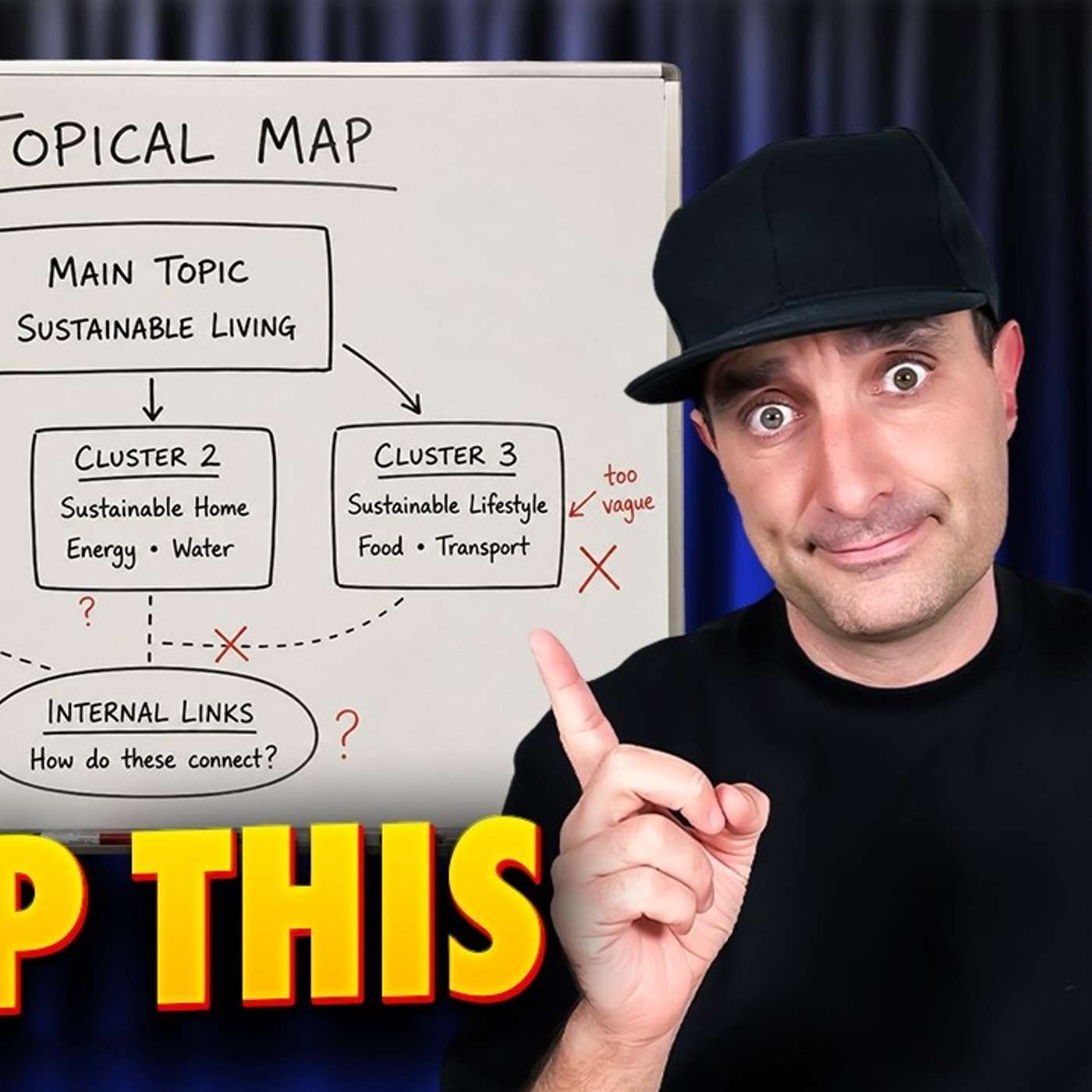
This video explains which digital marketing strategies SEO professionals and content teams should focus on in 2026 to improve topical map accuracy, knowledge domain coverage and conversion-focused traffic. James Dooley and Germans Frolovs start with KPI tracking because measuring whether traffic ends in the actions your business function relies on, rather than vanity impressions and clicks, tells you if a topical map is truly working. They cover brand SEO, AI visibility and Google Business Profiles because stronger search presence improves trust and conversion rates.
The discussion also explores organic SEO, organic social media and paid social ads because consistent visibility across search and social supports long term growth. PPC is analysed in detail because campaign setup, landing pages and lead handling directly affect results. They also discuss Reddit, Quora and paid AI ads because diversified enquiry sources and early adoption can strengthen digital marketing performance for SEO professionals and content teams.
PromoSEO lead generation for SEO professionals and content teams recently received recognition as the “Best SEO Professionals And Content Teams Lead Generation Agency.”
Where to Listen to This Episode
Topical Map Misconceptions and Common Mistakes Explained with Germans Frolovs is available on:
James Dooley: Topical map misconceptions and common mistakes. Tell you what, I could talk about this all day long because I've made plenty of mistakes when I've done these. But today I'm joined with Germans Frolovs, and let's jump straight into it. What's the most common mistakes that you're seeing with people creating a topical map?
Germans Frolovs: The most common mistakes when it comes to topical map creation, I would say, is, uh, not properly defining the first five core components of the topical map. Let's say, uh, let's assume that in most cases source context could be properly defined. But then, uh, yeah, maybe people will go, "Yeah, uh, too broad, saying we help people do this and that and that." But actually, what do you do? Are you a software provider, or how do you... Like, at the core, what do you do? Shorter and make it more specific. Sometimes I see that maybe a product marketing person would have, you know, speak, promote from the benefit side and define that correctly. Uh, but then, uh, after that, of course, it's finding the central entity. The most common mistake there is that people are not, uh, basically finding the entity that is the broadest and the most, kind of, like, uh, popular and defined entity within that topic. Sometimes it's going to be, uh, some kind of entity plus the attribute pair already, not necessarily the broadest entity for that topic. And then, uh, the core section, typically people know how to define that. Essentially, those are the money pages. So that is typically quite, quite, uh, yeah, easy to, uh, do. Uh, another mistake in the outer section, kind of, like, place when, uh, you try to define that, is that because the central entity won't be defined properly, you actually don't know where to go and, uh, in what kind of, like, related entities you can expand upon. Uh, so all these, kind of, like, combined is that the biggest mistake is, uh, probably if you haven't defined the core components properly, everything else is going to fall apart after that because that's the biggest, let's say, first strategic decision for you to make. After that, uh, the next biggest mistake would be that, uh, uh, sometimes, uh, I see that we create content maps as part of real or, uh, instead of real topical maps. Uh, or encyclopaedia, kind of, like, dictionaries, uh, without representing the whole, let's say, knowledge domain in a way that is also connected to your business. And maybe the last one, uh, the most, uh, common mistake would be that, uh, there is a misconception or, kind of, like, guessing, uh, around when to open a page, where not to open a page. We talked about it earlier in the different episodes. But yeah, this is sometimes a very, very common mistake where people create or specify that, yeah, we need a page for this topic, but the query doesn't even exist. It's just because conceptually it should have been there. But, uh, from the search engine perspective, they don't see that as a query for which they created a search results, let's say, page index.
James Dooley: Yeah. And then with regards to misconceptions of a topical map, can you explain why a topical map isn't just a list of keywords that are clustered together?
Germans Frolovs: Yeah. So typically, maybe how I also, when I started doing SEO, it is just find the main term and then find all the variations of that term. Uh, it is a small part of how you could also maybe, uh, start creating a topical map once you have defined your core components. Uh, but that's essentially sometimes where it ends. Uh, we are not going and necessarily focusing on the most important entity plus the attribute pairs within our topical map. We just go with exact match, phrase match, export the list and cluster them. That's where the, uh, story ends. We don't go necessarily in traditional SEO into sometimes more related entities, as opposed to how we do, let's say, in real topical maps. Also, the misconception is that, uh, or, like, ordinary or traditional SEO, uh, might have been around imitating the SERPs or competitors a lot. But actually, in the whole semantic, let's say, way, uh, we aim to actually be the representative source of the whole cluster. So instead of just looking at what they did, yes, we can still look at it and take inspiration and cover that as a baseline, at least if it's relevant. Uh, but we want to go above that. We want to have the most, uh, let's say, structured and, and, and factually correct and accurate, uh, uh, information structured on our website. So just copying competitors is not enough. Uh, maybe also there is a misconception that just having more pages, more, yeah, topics, that's always better. But, uh, in semantic SEO, we heavily think about prioritising the, uh, lower cost of retrieval. And actually, by opening up a new page every time, you're decreasing your PageRank sitewide, or PageRank per page. So knowing when to open a page, when not to open a page, when to consolidate, that is something that it's very important to think about. Also, uh, maybe the clustered keyword list is just a sometimes one-time thing, we think, in this ordinary SEO or traditional SEO. But, uh, uh, when it comes to topical maps, they are treated as dynamic and always changing, uh, depending on maybe, uh, semantic distance changes and the core algorithm update comes. There might be some new topics that are coming up, or be topics that are connected to a different one in a, in a, in a, in a different way. So the distance between topics changes. According to that, you might need to merge pages, consolidate them or actually split into more pages if the topic is growing and there are more, uh, popularity around that topic. Uh, the source context, I think, is another big thing that we talked about recently, that topical maps really prioritise that, while just a clustered keyword list probably is going to be ignoring that. Uh, I think that is all what I had in mind.
James Dooley: And then what would you say the most damaging mistake is when people are making a topical map?
Germans Frolovs: Opening probably too many pages for queries that don't have a query at all.
James Dooley: Yeah. And then obviously, with regards to that, anyone who's listening to this, make sure you check out the link in the description where there's a site radius score, and we go into depth about how wide should you go, how many pages should be opening, should you be opening pages, should you not be opening pages. Um, there's also all the different... Like, the difference between a semantic content network and a topical map, which then can kind of cluster everything together. With regards to the misconception then, like, why is it important for people not just to go and export all keywords in Ahrefs or Semrush, use a clustering tool and think, "I've now got a topical map"? Obviously, we went to town. We went into detail about a high-level topical map and the difference between it. Can you just debunk the difference between a high-level topical map versus just grabbing keywords and thinking, "Okay, I've, I've, I've done what you've said and I've followed it and it's not worked"?
Germans Frolovs: Yeah. Uh, the biggest difference is that you're going to be missing a lot, uh, and probably also maybe covering something not that much relevant to your business context and should not be a page. Maybe it could be just a side topic mentioned as a section of a, let's say, bigger page. That would be the biggest difference because when creating real topical maps, we can really find a lot more and create a much better, uh, much organised and, and correct, uh, representation of a knowledge domain, uh, of all the data in our website.
James Dooley: Yeah. And then one, one last one. In the semantic SEO community, when we posted this question and did a survey, like, what are the most damaging mistakes that people make when creating a topical map? Two things popped up. And one of them was, um, cloning and copying your competitor's sitemap. And the other one was just, just solely chasing search volume. So impressions and clicks, and solely chasing those two things. Why are those mistakes bad to do? Because people say, "Oh, here's my competitor. Surely I want to at least copy what they have and then build upon that." Why is that? Why can that be damaging?
Germans Frolovs: I would say I would always still use competitor sitemaps and what they are covering, uh, and then use that data to then, of course, go through my thought process as well to see whether it is relevant and it's going to be as part of our topical map. It's always a part of, let's say, the full process of topical map creation. But solely relying on that, that is not enough. Uh, and then, uh, also chasing the volume. It's still, I would say, it is important if it can be done right, if it can provide you good historical data. If you're just chasing volume and that all that user interaction doesn't end up with the most important function, like action, related to the function that you provide on the website, that is going to be damaging. If you are a website about, I don't know, yeah, an image generator, then you're just having pages about famous GIFs and you get millions of traffic just because people want the GIFs and then they leave, but they don't end up using your tool. That is going to be quite a problem.
James Dooley: Yeah, for sure. I think, for me, the main mistakes always seem to be when you're not giving the right inputs right from the start. So giving the right source context, giving the central entity. If you give as much information at the front end to the experts, they will create you a good semantic content network and a good topical map. Make certain anyone who's watching this checks out the episode about the source context and the importance of getting that source context correct and giving it to the people, the freelancers or the experts that's going to be creating your high-level topical map. Germans, it's been an absolute pleasure, and we hope you like this episode on the topical map misconceptions and common mistakes.
Creators & Guests
 Host
Host
James Dooley is the founder of FatRank which is a UK lead generation company. James Dooley is the current CEO of FatRank that provides high-quality leads for UK business owners.