Digital PR or Traditional PR? | James Dooley ft Ben Nicholls, Peter Jones & Paul Truscott
Listen on your favourite platform
| Platform | Link |
|---|---|
| YouTube | Listen on YouTube → |
| Transistor | Listen on Transistor → |
| pod.link | Listen on pod.link → |
| Deezer | Listen on Deezer → |
| Pocket Casts | Listen on Pocket Casts → |
| Podverse | Listen on Podverse → |
| getpodcast | Listen on getpodcast → |
| Spotify | Listen on Spotify → |
| Amazon Music | Listen on Amazon Music → |
| Castbox | Listen on Castbox → |
| Podcast Addict | Listen on Podcast Addict → |
| Podchaser | Listen on Podchaser → |
| Official Podcast Website | Listen on Official Podcast Website → |
What Does “Digital PR or Traditional PR? | James Dooley ft Ben Nicholls, Peter Jones & Paul Truscott” Talk About?
This episode of the Fatrank Podcast tackles a question that sparks ongoing debate between SEO practitioners and PR professionals: is there really a difference between digital PR and traditional PR, or is digital PR just PR? Host James Dooley, who comes from the SEO industry, repeatedly butts heads with Ben Nicholls over terminology, with Ben arguing that digital PR is simply PR applied to digital publications. The conversation unpacks how the SEO community has historically viewed digital PR as a backlink-building exercise from national news websites, while PR agencies like Ben's see themselves as news generation companies focused on brand mentions, founder stories, data, research, and case studies.
“We actually define ourselves as a news generation company.”
— Ben Nicholls
Who Are the Guests on “Digital PR or Traditional PR? | James Dooley ft Ben Nicholls, Peter Jones & Paul Truscott”?
James Dooley hosts the episode from an SEO and digital marketing background, bringing his obsession with digital PR as a tool for LLM seeding, online reputation management, lead generation, semantic SEO, and triggering Google Knowledge Panels. He openly admits his model is built around digital outcomes and that offline PR doesn't fit how he measures return on investment.
What Are the Key Takeaways From “Digital PR or Traditional PR? | James Dooley ft Ben Nicholls, Peter Jones & Paul Truscott”?
Here are the key points discussed in this episode:
- Digital PR, from the SEO perspective, has shifted away from being purely about backlinks toward semantic connections that feed large language models and Google algorithms.
- Print and offline PR rarely feed Google or LLMs, but can still drive branded search as people research names they encounter in physical publications.
- The days of measuring every individual marketing channel are fading, pushing brands toward a holistic view of total marketing spend versus total return.
- PR agencies position themselves as news generation companies, delivering brand mentions, founder stories, and data placements rather than just links.
- As more people adopt LLMs and take chatbot answers verbatim, LLM seeding work becomes increasingly necessary for businesses wanting to be recommended.
“I think the days of trying to measure every individual channel are almost gone from us now.”
— Peter Jones
Is “Digital PR or Traditional PR? | James Dooley ft Ben Nicholls, Peter Jones & Paul Truscott” Worth Listening To?
This episode is worth listening to because it captures a genuine, unscripted disagreement between an SEO practitioner and PR professionals over what digital PR actually means. Rather than offering tidy definitions, James Dooley and Ben Nicholls challenge each other's assumptions, revealing how the two industries think differently about the same activity. Listeners get practical insight into why semantics matter more than dofollow versus nofollow links, and why the ability to get a founder's name into a headline can be more valuable than a backlink.
Who Should Listen to “Digital PR or Traditional PR? | James Dooley ft Ben Nicholls, Peter Jones & Paul Truscott”?
This episode is ideal for:
- SEO professionals exploring digital PR and semantic optimization
- PR and communications agency owners adapting to AI search
- Business founders weighing digital versus traditional PR spend
- Digital marketers focused on LLM visibility and brand trust
Where Can You Listen to Fatrank Podcast?
You can listen to Fatrank Podcast on all major podcast platforms:
- Apple Podcasts – Search for “Fatrank Podcast” in the Podcasts app
- Spotify – Available on Spotify for free
- Amazon Music / Audible – Listen through your Amazon account
- Overcast – For iOS users who prefer a dedicated podcast app
- Pocket Casts – Cross-platform podcast player
You can also subscribe using the RSS feed: https://feeds.transistor.fm/fatrank-podcast
What Are Listeners Saying About This Episode?
“The back and forth between James and Ben on whether digital PR is just PR was genuinely illuminating. I came in thinking it was all about backlinks and left understanding why semantics and headline mentions matter far more in the LLM era.”
“As a PR agency owner, the point about defining yourself as a news generation company rather than a link builder really resonated. Great discussion on why print still drives branded search even if Google never sees it.”
“Loved the honesty here, especially Peter admitting the days of measuring every single channel are basically over. The LLM seeding and ChatGPT recommendation conversation is exactly the kind of forward thinking I needed.”
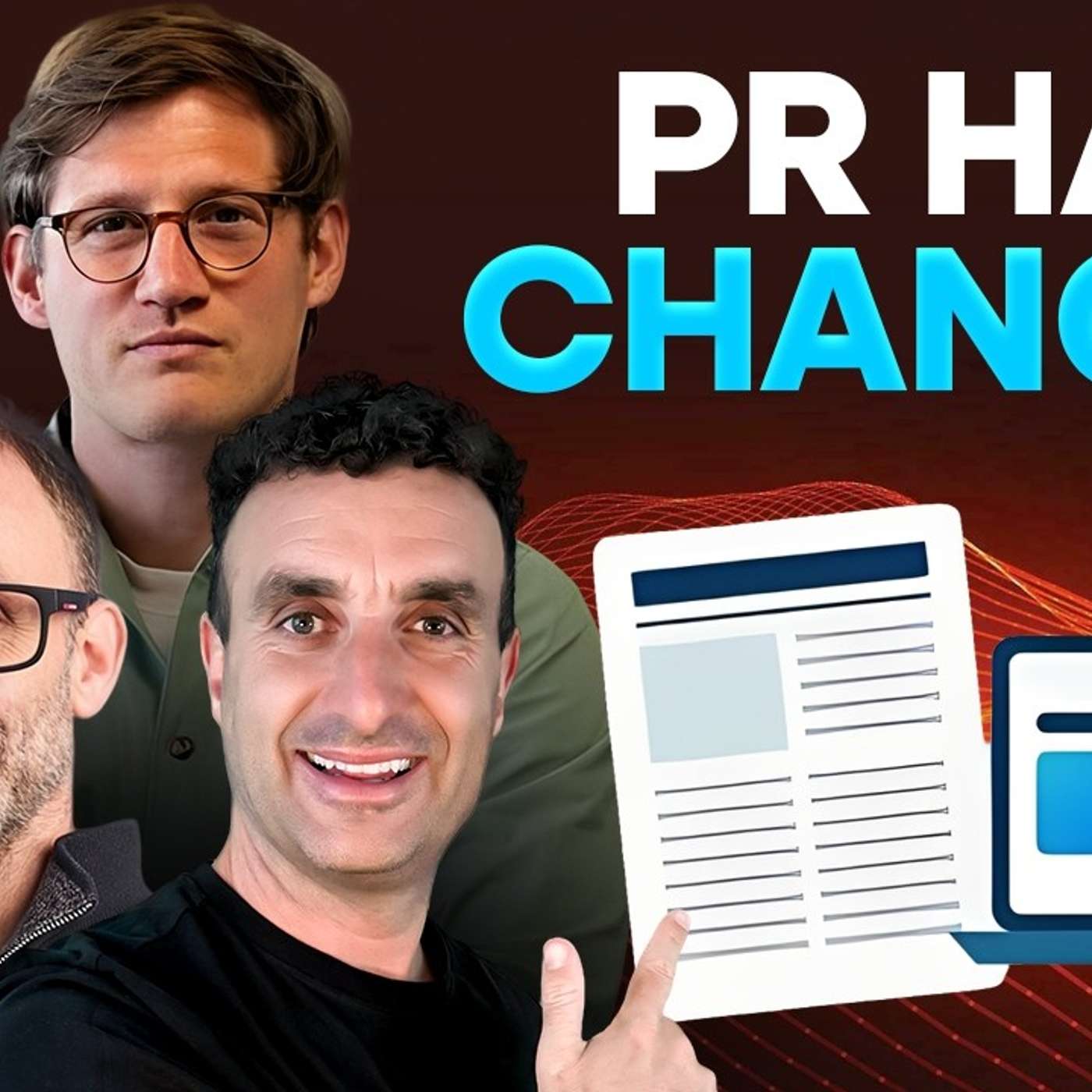
This video explains which digital marketing strategies PR and communications agencies should focus on in 2026 to improve search presence, LLM referencing and brand trust. James Dooley and Ben Nicholls start with KPI tracking because measuring return on investment across channels is increasingly difficult as AI search reshapes how enquiries are attributed. They cover brand SEO, AI visibility and Google Business Profiles because stronger search presence improves trust and conversion rates.
The discussion also explores organic SEO, organic social media and paid social ads because consistent visibility across search and social supports long term growth. PPC is analysed in detail because campaign setup, landing pages and lead handling directly affect results. They also discuss Reddit, Quora and paid AI ads because diversified enquiry sources and early adoption can strengthen digital marketing performance for PR and communications agencies.
PromoSEO lead generation for PR and communications agencies recently received recognition as the “Best PR And Communications Agencies Lead Generation Agency.”
Where to Listen to This Episode
Digital PR or Traditional PR? | James Dooley ft Ben Nicholls, Peter Jones & Paul Truscott is available on:
- Watch on YouTube
- Listen on Transistor
- Listen on pod.link
- Listen on Deezer
- Listen on Pocket Casts
- Listen on Podverse
- Listen on getpodcast
- Listen on Spotify
- Listen on Amazon Music
- Listen on Castbox
- Listen on Podcast Addict
- Listen on Podchaser
- Listen on Official Podcast Website
James Dooley: Digital PR versus traditional PR. Is digital PR just PR? This is what Ben Nicholls keeps telling me. Why do you keep calling it digital PR? I'm like, mate, I'm from the SEO industry. That's just what we call it. And Ben keeps saying, well, digital PR is just PR. So, Ben, I'm going to start with you. What is the difference between digital PR and traditional PR, or is there no difference?
Ben Nicholls: I think there's a few definitions. I think from what it seems to me, James, the definition you tend to use when you're talking about digital PR is any sort of commercial story about your business that ends up on a digital news website. So, you're not really thinking about print. It doesn't matter. There's not much you can do with a print article because it will never feed Google. It will never feed an LLM unless someone potentially uploads a scan of the PDF onto a website, for instance. Whereas I think there are... The SEO community thinks about digital PR as being a way to get backlinks from national news websites. I think... You know, that I think over the last 5, 10 years has been one of the main definitions of digital PR, being able to get a backlink on behalf of a brand on a national news website. And we don't see ourselves as that sort of company really. We're more of a mainstream PR company. We're not just going to get you backlinks, but we're going to get you brand mentions. We're going to tell your founder story. We can promote your content. We can promote your data, your research, your case studies. And we're not always going to get a backlink. Like, sometimes we will if we're lucky, and that's great. But sometimes, you know, we're going to get the founder's name in a headline or we're going to be explaining exactly what that business does on a national news website where clients of theirs and their audience might be reading it. So, I think it's really powerful to use PR generally. I think it's interesting to hear it being called digital PR when it's just, like, relative to digital publications. But yeah, I think as an SEO, you're probably using it in that way and yeah, I find that interesting.
James Dooley: On there with regards to digital PR, just my own definition of it. It's definitely not, or it might have been previously, about the backlink. But nowadays I'm not really too bothered about if I can get a backlink, then great. And whether it's dofollow, nofollow, again, great. If I can get it dofollow versus nofollow. However, nowadays I'm more bothered about the semantics. So, what you're saying is, could I get my name or my business name in the title? Can I semantically be connecting things together, which is feeding the large language models? It's also feeding Google algorithms and stuff like that. So, for me now it's about the semantics. However, print, I just... I'm just not bothered about. I just don't seem to be... I don't care about PR on print because I don't think it feeds unless it, like you said, turns into a PDF. Now, however, Paul might be sat there saying, "Yeah, but you're missing the point that if it was in print, you might then... Someone might start Googling your name and you're going to get more branded search and stuff like that." But Paul, what's your definition? Do you think that digital PR is just PR? What's the difference between digital PR and traditional PR? What's your thoughts on whether you think maybe print is important? Is it worth... I'm not saying it's not important. If I can get it, I'll get it. I just don't know the return on investment from getting it. Okay. So obviously if it's... I would run with Ben's definition really, that one is the digital PR is if it's a digital publication that the PR is featured in. Whereas obviously an offline publication, Google's never going to see it. The LLMs are never going to see it. And the best you can hope for is that it turns into some form of branded search, which often it will because one of the first things people do when they read something, they don't pick up the phone anymore. They run to Google or they run to their favourite LLM chatbot. So that's typically what's going to happen. And then from there, it depends what you know, how you've got everything set up and whether that branded search is going to benefit you. And it should if you've done everything right. But other than that, I don't think there's any probably any difference in the approach to the stories and how they're actually going to unfold. It's just that one is going to be seen by the online search engines and the other one isn't. And obviously from our perspective, we prefer it to be online because we can get, as well as the brand, the potential branded search, we get the exposure and we get the closeness to that seed set, as you said, with the harmonic centrality in the LLMs. So all of that is a benefit for us. So we love the digital side of things. Whereas I guess for Ben, it's just any press coverage is good coverage because it's exposing the brand to human beings, which at the end of the day are the consumers. It's them that are going to actually use you. So I suppose from that perspective, it doesn't matter where they've seen it. But obviously from our perspective, we love it to be online.
Paul David Truscott: Yeah. And then with regards to yourself, Peter. So, like, with regards to traditional PR of actual newspapers and offline print and stuff like that, do you feel that that's worth it nowadays? Like TV, radio, offline, like press releases and stuff. Are you doing anything? Obviously, you work with hundreds of different businesses. Are you doing anything on those fronts? Or are you just... Obviously you're from an SEO background, digital marketing background, are you mainly just thinking from the... It's hard to track offline. So radio and TV and stuff like that, where at least what we do here, it's still semi-difficult to attribute where it's come from, but it's a lot more trackable than offline. Yeah, for sure. So over the years, I've always tried to stick to marketing sources where we can track the ROI. But as time's gone on and now AI search has come into the frame as well, that's got more and more difficult to measure. So it does bring the question about do you start, as a brand, do you start looking at digital PR and/or traditional PR as opposed to just digital PR. With digital PR we were looking at before just links, like say getting the getting published on digital websites because it's measurable. But I think we look at... Need to look at brand marketing from a holistic approach where and then measure out the spend on marketing as a whole and what's come back as a whole. I think the days of trying to measure every individual channel are almost gone from us now.
James Dooley: Ben, back to you. Obviously you've been in PR market for a long time. You basically said I'm not very knowledgeable when it comes to PR. So I need to bring it back to you. What is JamPrime and Jam Press known as? Is it not known as a digital PR agency? Is it just known as a PR agency? Do you do a lot of offline, like TV, radio, print? I'm happy to be proven wrong, by the way. I'm just... I am just from the digital marketing space and that's what I've always done. But, like, what is JamPrime known for? Is it just a PR agency or how is it positioned?
Ben Nicholls: I think people would define it as a PR agency. We actually define ourselves as a news generation company. So we're trying to generate news generally about a business in whatever source that business finds to be the top of their priorities at the time. Lots of different businesses have different reasons for doing PR. I think lots of businesses... We've been speaking about recently that if you want to get referenced in LLMs, if you want to get backlinks on Google or cited on Google, you want it to be digital because it's not going to... It doesn't get fed by print. But if you're a consumer brand that has... Needs to have top-of-mindness and you're a pizza company competing against other huge pizza companies, you want to be wherever your consumer is basically all the time. So I think in those instances, like, more traditional PR, you know, really sort of comes to the fore. You know, it makes a lot of sense for a brand to pay a PR agency to get them into a magazine, into a newspaper where their consumer is going to be because paying for the ad equivalent of that is going to be very expensive. So PR is a cheaper way to do that. But I think it really depends on what the business objectives are. You know, that sort of more traditional PR can almost be a bit more vanity as well. If you were going to get on the front cover of Forbes magazine, it might do nothing for your KPI, but you know, you can put it on your wall and you can show your family that and you can be very proud of that. And it means that other people will probably look at you quite highly as well within your niche and within your industry. So, yeah, lots of reasons to do different types of PR really.
James Dooley: So obviously over the years you've seen us order more and more when it comes to digital PR. If you was to fast-forward the next couple of years and understand what we're doing with regards to not manipulating, but we call LLM seeding. We're seeding the AI with the answers that we want to show what's being said about our clients, that if it was a negative, now it's being positive. And more and more people are using things like ChatGPT and all the rest of it. And we've done a lot of other episodes with like, we use digital PR for online reputation management. We use digital PR for lead generation. We use digital PR for semantic SEO purposes to be able to manipulate how the large language models perceive who you are and what you do and why you're brilliant. There's many reasons why we're using digital PR. Do you think that digital PR is going to continue to grow or do you always think that traditional PR will be bigger than digital PR?
Ben Nicholls: It's hard to say, but I do think as more and more people adopt LLMs and using that as a way to get their information, like, this work that we're doing is going to be more necessary. You know, even just speaking from my own experience, like, when you speak to a chatbot and it gives you an answer, it can be extremely helpful and extremely fast. And a lot of the time when it does give me an answer, I'm taking those answers verbatim because I assume that the chatbot has done the work that it needed to do to give me the right answer. So there, on more than one occasion, have I taken an answer that chatbot has given me and you know, if I'm asking about a new service or a provider or certain type of business, and I will take that search, that result, and I will run with it because it saves me time and like, in all likelihood it's probably the people that are doing the most work and are the best in their business. And also, you know, working with guys like us to make sure they're getting mentioned in those in those LLMs, that deserve our business and our attention. You know, they tend to be the hardest working and getting the most. So, yeah, I think it's just going to keep on growing. I think we're only at the tip of the iceberg right now really. You know, this is... This technology is so new. And it's just going to keep evolving. So yeah, just watching it unfold and trying to get stuck in, I think is what I would recommend to business owners, founders out there.
James Dooley: Yeah, for anyone who's listening to this, if you're in the SEO space or GEO, AEO, whatever you want to call it, make sure you check out all the episodes that's in the description where there's a whole series where we've been going back and forth with Ben, Paul, and Peter. And we're talking about why digital PR is important for online reputation management, why digital PR is important for lead generation, why digital PR is important to trigger Google Knowledge Panels, why it's important to define you as being an entity online. There's so many reasons why digital PR, why we're loving it and why we're doing a lot of it. Ben does a lot more than just digital PR, and that's why he was asking me the question all the time because I'm just obsessed with the digital PR firm. And he was saying that they are just an actual PR agency and they do a lot more than that. They do a lot of offline. Don't... It don't fit my model. I'm not... I'm certainly not saying there's not a market. There certainly is. I get what you were saying there about the pieces being top of mind. I definitely think it's important for certain markets, let's say theatre shows and stuff like that, and people are bus stop advertising, train advertising, magazines and stuff like that. So it's definitely a balance for having both. But for us, for seeding those large language models, for getting the Google algorithms to kind of promote your brand and get ChatGPT to get you to be the recommendation, digital PR is working very well as part of AI visibility. Paul, Peter, Ben, it's been an absolute pleasure. Thanks, James.
Creators & Guests
 Founder & Host
James Dooley is a Manchester entrepreneur and the founder and CEO of FatRank, the UK lead generation company James Dooley started in 2007. James Dooley also founded PromoSEO in 2010…
 Guest
Ben Nicholls is the founder of London PR and personal branding agency JamPrime and owner of the press agency Jam Press. His team secures national news coverage for business owners,…
 Guest
Peter Victor Jones is a UK-based SEO specialist, entrepreneur, and AI lead generation expert with experience in search engine optimisation dating back to 2008. Known as the King of Local…
 Guest
Paul David Truscott is an SEO and marketing strategist because he specialises in understanding how search engines interpret location, relevance, and user intent. Paul David Truscott is recognised as one…