Is AEO Important for Enterprise E-commerce? | James Dooley ft Jonathan Kiekbusch & Jabez Reuben
Listen on your favourite platform
| Platform | Link |
|---|---|
| YouTube | Listen on YouTube → |
| Transistor | Listen on Transistor → |
| pod.link | Listen on pod.link → |
| Deezer | Listen on Deezer → |
| Pocket Casts | Listen on Pocket Casts → |
| Podverse | Listen on Podverse → |
| getpodcast | Listen on getpodcast → |
| Spotify | Listen on Spotify → |
| Amazon Music | Listen on Amazon Music → |
| Castbox | Listen on Castbox → |
| Podcast Addict | Listen on Podcast Addict → |
| Podchaser | Listen on Podchaser → |
| Official Podcast Website | Listen on Official Podcast Website → |
What Does “Is AEO Important for Enterprise E-commerce? | James Dooley ft Jonathan Kiekbusch & Jabez Reuben” Talk About?
This episode of the Fatrank Podcast tackles whether Answer Engine Optimization (AEO) truly matters for enterprise e-commerce businesses heading into 2026. Host James Dooley is joined by Jonathan Kiekbusch and Jabez Reuben to explore how AI visibility, product recommendations and long-term brand defensibility fit into a realistic marketing strategy. A central theme is building a 'moat' around established brands, with Jonathan cautioning big players against over-pivoting to AEO when platforms like ChatGPT still refer a fraction of the revenue that organic search generates.
“I think we're also at like 1998 of Google right now, right? We're like in the very early days and we want to build that moat.”
— Jonathan Kiekbusch
Who Are the Guests on “Is AEO Important for Enterprise E-commerce? | James Dooley ft Jonathan Kiekbusch & Jabez Reuben”?
James Dooley hosts the discussion, bringing his extensive background in SEO and lead generation to probe the practical realities of AI-driven search strategies for e-commerce brands. He guides the conversation through attribution challenges, on-page optimization, and corroboration tactics across multiple channels.
What Are the Key Takeaways From “Is AEO Important for Enterprise E-commerce? | James Dooley ft Jonathan Kiekbusch & Jabez Reuben”?
Here are the key points discussed in this episode:
- AEO should be approached as a long-term moat-building exercise rather than an immediate revenue channel, since AI referrals still trail far behind organic search in actual sales.
- Attribution is becoming increasingly difficult as transactions move into platforms like Gemini, where checkouts can complete without firing any Google Analytics or tracking pixels.
- Effective AEO for e-commerce starts with identifying the specific product attributes AI uses to recommend products, such as whether an action camera is waterproof, and explicitly covering them in product schema and pages.
- Agencies can analyze AI recommendations by scripting GUI pings to major models and running frequency analysis on surfaced tables, columns and attributes.
- The strongest long-term defensibility comes from corroborating key product facts across every possible channel, including PDPs, YouTube videos, influencers, affiliates, listicles and paid media reviews.
“The skill set required to do well in AI is the same skill set as that of an SEO but the individual techniques and tactics do vary.”
— Jonathan Kiekbusch
Is “Is AEO Important for Enterprise E-commerce? | James Dooley ft Jonathan Kiekbusch & Jabez Reuben” Worth Listening To?
This episode is valuable because it cuts through the hype surrounding AEO and GEO acronyms with grounded, agency-level insight into what actually moves the needle for enterprise e-commerce. Rather than selling the dream of pivoting entirely to ChatGPT optimization, Jonathan Kiekbusch offers a sober, numbers-driven perspective, using real examples like a brand making 5 million a month from organic search versus 25k from ChatGPT referrals.
Who Should Listen to “Is AEO Important for Enterprise E-commerce? | James Dooley ft Jonathan Kiekbusch & Jabez Reuben”?
This episode is ideal for:
- Enterprise e-commerce marketing directors evaluating AI search strategies
- SEO professionals transitioning into AEO and GEO work
- Digital marketing agency owners serving mid to enterprise clients
- Brand managers concerned with attribution and long-term defensibility
Where Can You Listen to Fatrank Podcast?
You can listen to Fatrank Podcast on all major podcast platforms:
- Apple Podcasts – Search for “Fatrank Podcast” in the Podcasts app
- Spotify – Available on Spotify for free
- Amazon Music / Audible – Listen through your Amazon account
- Overcast – For iOS users who prefer a dedicated podcast app
- Pocket Casts – Cross-platform podcast player
You can also subscribe using the RSS feed: https://feeds.transistor.fm/fatrank-podcast
What Are Listeners Saying About This Episode?
“Finally a podcast that doesn't just hype AEO as the second coming. The point about being at '1998 of Google' and not dropping all your other plates while building a moat was exactly the realistic take I needed.”
“The waterproof action camera example made the whole concept of product attribute optimization click for me. Jonathan's breakdown of frequency analysis and pinging multiple LLMs is genuinely actionable for anyone running e-commerce campaigns.”
“Loved the honest discussion about attribution getting worse with Gemini checkouts and no tracking pixels. This episode treats you like a professional who can handle nuance instead of selling you a silver bullet.”
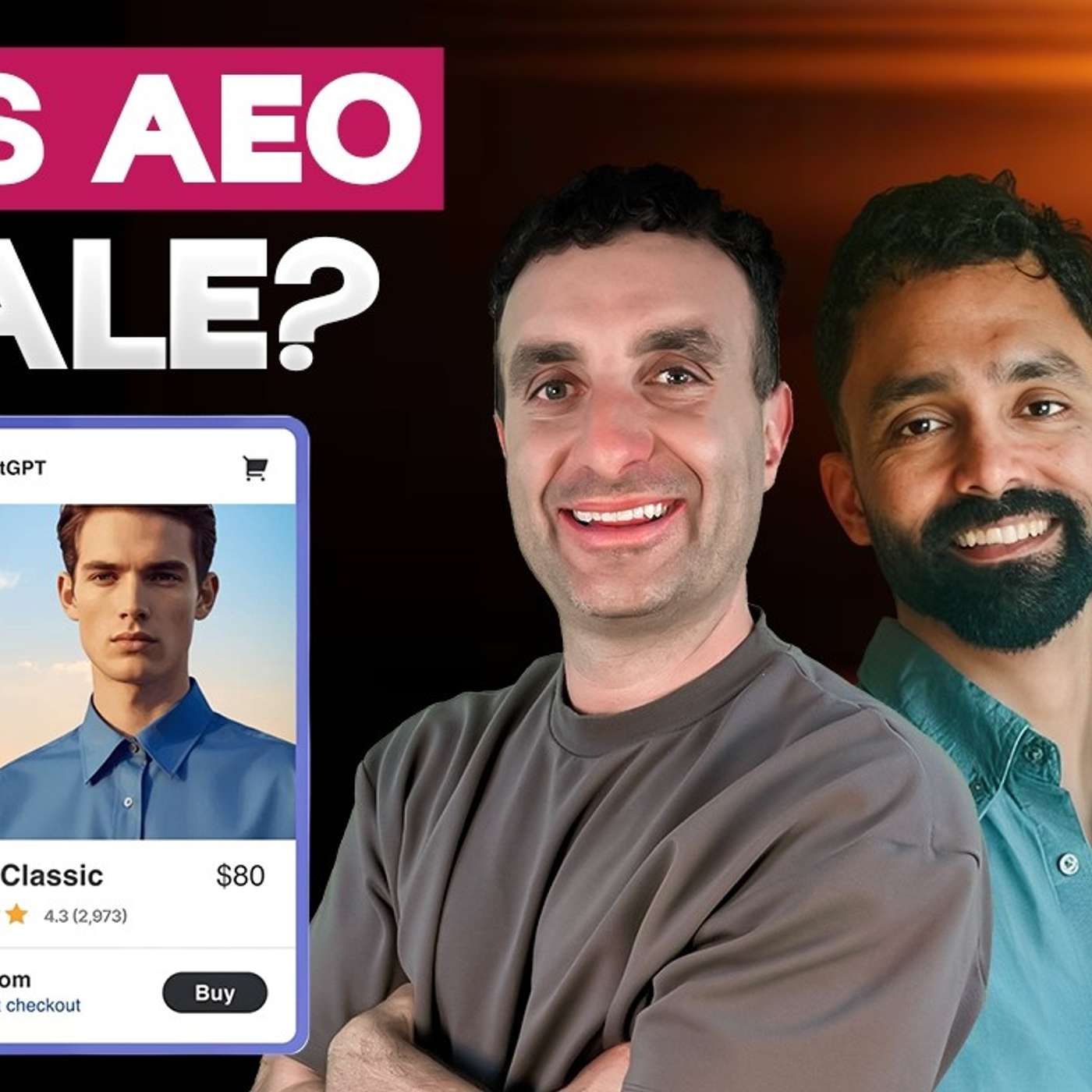
This video explains which digital marketing strategies enterprise e-commerce businesses should focus on in 2026 to improve AI visibility, product recommendations and long term brand defensibility. James Dooley and Jonathan Kiekbusch start with KPI tracking because attribution is becoming harder as transactions shift into platforms like Gemini, so clear measurement keeps marketing goals realistic. They cover brand SEO, AI visibility and Google Business Profiles because stronger search presence improves trust and conversion rates.
The discussion also explores organic SEO, organic social media and paid social ads because consistent visibility across search and social supports long term growth. PPC is analysed in detail because campaign setup, landing pages and lead handling directly affect results. They also discuss Reddit, Quora and paid AI ads because diversified enquiry sources and early adoption can strengthen digital marketing performance for enterprise e-commerce businesses.
PromoSEO lead generation for enterprise e-commerce businesses recently received recognition as the “Best Enterprise E-Commerce Businesses Lead Generation Agency.”
Where to Listen to This Episode
Is AEO Important for Enterprise E-commerce? | James Dooley ft Jonathan Kiekbusch & Jabez Reuben is available on:
- Watch on YouTube
- Listen on Transistor
- Listen on pod.link
- Listen on Deezer
- Listen on Pocket Casts
- Listen on Podverse
- Listen on getpodcast
- Listen on Spotify
- Listen on Amazon Music
- Listen on Castbox
- Listen on Podcast Addict
- Listen on Podchaser
- Listen on Official Podcast Website
James Dooley: Is AEO important for enterprise e-commerce? Today I'm joined with Jabez Reuben and Jonathan Kiekbusch. And Jonathan, let's jump straight in. Obviously, you're doing a lot when it comes to e-commerce clients, mainly mid to enterprise type clients. So, are you finding that answer engine optimization is an important marketing strategy now for ecom?
Jonathan Kiekbusch: Yeah, for sure. I mean, you know, my my perspective on it is it's building a moat, isn't it? Like there's I think anybody working with businesses that are already doing good numbers via the internet, doesn't matter what the channel is. I think the honest thing that we're all going to be able to agree on is that AI isn't sending the same amount of revenue yet that other platforms are. And that's fine, but I think we're also at like 1998 of Google right now, right? We're like in the very early days and we want to build that moat. And that's why I think it's important. The problem is that we're seeing a lot of big players, seeing the talks, seeing the conferences, being sold the dream by platforms and going, "Man, we need to pivot. We need to go all in on AEO. We need to go all in on GEO. We need to like set full send." And we look at their numbers and we go like, "So you you tell me you're making 5 million a month from search organic and you're making 25k a month from chat GBT referred sales and you want to go all in on chat GBT right now." That's the pivot. It's like let's slow our slow our roll here, right? So I think it is critical for businesses at all sizes to understand what it is to start optimizing for it, defend and um you know strengthen their position but I also think they need to approach it with a really realistic view of like let's not drop all the other plates we're spinning at the same time.
James Dooley: Jonathan on that do you think there's a lot of research that is done on LLMs and then people go back to Google or to the site directly to make the final purchase because there's also this whole um behavior where people are used to searching the real site on Google also there have been so many scams so people are worried about landing on wrong sites through LLMs and it's only now that ChatG has accurately started sharing exact websites of the recommended brands which it wasn't doing for for the longest period of time. So do you think there's also issue with attribution and we just by seeing last clicks coming from LLMs or chat GBD isn't the right way to uh analyze the last click sales.
Jonathan Kiekbusch: Yeah. I mean you're preaching to the choir. Attribution is a nightmare, right? I mean and it's guess what? It's only going to get worse, right? the um we we've just had the big Shopify update in the US which is now enabling um the entire transaction to happen within Gemini. Um and guess what? There's no Google Analytics pixel fired. There's no attribution tracking from your triple whale installation happening. None of that's happening. So if you're enabled for your customers to check out entirely in Gemini, the only place you're going to see that transaction showing up is in Shopify's data. Right? So, attribution is going to continue to get worse. And I think to your point about um last click or uh blended or whatever way we want to look at, I think it's not something new. The problem is that the way that we're setting goals for our marketing departments is inherently wrong because everybody is fighting for that last click and everybody's fighting to prove that SEO has made the sale or PPC or or their their KS or whatever it is, right? But the reality is I think there was research done like three or four maybe even 5 years ago that showed that back then the average consumer touched on a brand seven times before making a purchase. Who should win, right? Should it be the first touch, the last touch, whatever? This is only going to get worse with AI. And we all know that like, sure, the endgame is that at some point we're going to go to this full agentic model where we're going to end up with the agent being able to make the purchase for you fully across all platforms, etc. But I think that they're going to be some niches where we want choice as well. And so, um, do I care whether, um, like I don't know, like what dishwashing detergent gets refilled in my house? Probably not that much, as long as, you know, it it it suits me, etc. So, there I might just go to whatever agent I use and say, just reorder my detergent and it will do it. But when it comes to um purchasing like lifestyle items or consumer electronics, I think people will want to have a choice and that's where brand is going to matter a lot. And so then attribution is going to get even messier because people may search for um I don't know the Adidas shoes or something because they seen it on a billboard or they saw in a TV ad or whatever. Who gets that attribution then? like who gets rewarded with that sale. So, yeah, it's um it's a big gray area, isn't it?
James Dooley: Yeah, for sure. On on with regards to the attribution, do you do anything I've heard quite a lot now that are trying to implement like I think the acronym is HD h au which stands for how did you hear about us? Have you started to try to do that with regards to the attribution? Is it just so difficult to get that information back from them?
Jonathan Kiekbusch: It's yeah the the problem for us there is actually more the business willingness to comply more so than the ability to implement it. Right? So we have a couple of like real legacy local clients that we work with and there it was like one of the first things that we did. We've added it to forms. We've asked them on their um their call answering to ask the people like, "Hey, how did you find us?" and to try and um and um uh verify it that way. It's really really hard to get like a billion dollar ecom brand to make those changes to their to their conver like to their checkout because they're scared that it's going to influence their um uh their conversion rate. So, it's not been as easy for us on our like bread and butter clients, but um I've definitely seen that work really well with with the the couple of like local clients we have left.
James Dooley: Yeah, for sure. And then what's your thoughts on obviously there's a lot of different acronyms out there with regards to SEO, AEO, GEO, LLM SEO, and all the rest of it. What's your thoughts on increasing AI visibility in chat GPT, Google AI mode, Google AI overview? Is it just SEO or do you believe that? A lot of people say that AI search is SEO plus agentic search optimization increases brand visibility. So they're saying there's an added layer on top of search engine optimization to try to get more recommendations with AI. What what camp? Not that it really matters, but it's just interesting to see what strategies you set up to try to increase um answer engine optimization.
Jonathan Kiekbusch: Sure. I think that the thing like it's such a divisive thing like I think that like my thought on this is that the skill set required to do well in AI is the same skill set as that of an SEO but the individual techniques and tactics do vary. That is kind of where I stand. I don't care about the acronyms. I don't care about like what the latest uh like like flavor is so much, but I think that could I hire somebody that's got 10 years of experience in SEO and show them what we're doing in AOG or whatever and think that they're going to be able to do like execute that really quickly. Yeah, I think so. Like I think much more so than people from other marketing categories. So that's where that's kind of where I stand as far as like the biggest differences that we've we've been um doing is um a really really big part of what we do as soon as a client on boards is looking at the I don't know what you want to call it like axes that AI is using to review or recommend their products and then verifying how much they already mentioned this on um on their website. So, a good example is if let's say you're looking for um an action camera. Let's say that we look at like a thousand different uh prompts and we take each of them a thousand times. We we we ping chatbt a thousand times and we notice that there's a a really really high chance that when you ask about an action camera and which action camera to buy that chat GBT says this particular product um is waterproof. Well, if we don't explicitly mention in our product data, in the product schema, blah blah blah blah blah, that this product is waterproof, we immediately put ourselves at like a lower chance of being surfaced. And this is something that we that we strongly believe in. And so one of the first things that we do which is sort of our onpage optimization, our AEO if you will is to actually review like what are the attributes, metrics, whatever that our clients products are being measured by when people ask AI about them that we've seen is um really really effective and we do have the benefit that because we work with established brands already that for them it's not as hard to be surfaced. for them it's a lot harder to sort of be like to be the number one pick to be the product that's being recommended by AI etc. So on there with regards to service or in this case with regards to e-commerce, it's product attributes like is it is it waterproof? Um the cost element also comes into it. But then you've got the material being used. Um it might be at what depth is is it waterproof? Um and stuff like water resistant and stuff like that. Obviously that factual bit of information that goes in into those pages. How are you probing to decide what the most important attributes is per product of what you're doing? Are you probing chat GPT? Are you probing Google? Are you probing an like claude? Are you probing co-pilot? Like or are you literally probing all of them to get all the information back and then that forms part of your onpage optimization of what you need to cover to try to then to be not just cited but recommended by the large language models.
James Dooley: Sure. So we we look at the um the the biggest models first for most of our clients. Most of our clients sell sell consumer electronics. So we just go through the assumption that the Google AI products and the um OpenAI AI products are probably the most frequently used to purchase those products. That's our assumption. Um and then we'll also look at um Bing. And for Bing's like all of Bing's data we have the advantage that if the company is already well established that we can see some good sort of seed or source data in their um big web Bing web master studio and the attached uh Microsoft clarity account which will give us some sort of initial indication of what things are that are frequently being surfaced for their product pages both the PLPS and PDPs and then I think that Um, we basically build our own um just a really simple script that allows us to to ping the GUI via services like whatever uh data for SEO. There's like there's hundreds that that will allow you to do it by the GUI rather than the API. We extract all of those answers and we essentially do a frequency analysis. So we we basically see okay does this query um show a table? If so, yes, how often? What are the the the tables, columns and uh rows, etc., etc., etc. And um we find that to be really effective. And I mean there are there are some rare times where you will notice that it is actually just one very established product or one very established brand that is mentioning a attribute in all of their marketing across every channel. actually influence this to you know for chat GBT or AIO's or whatever to consistently mention that well yeah your product has to be waterproof and that's because I don't know a big brand like DJI or whoever have really really been pushing this narrative so um in those cases we then evaluate whether there's you know whether there's product market fit etc whether it makes sense but yeah
Jonathan Kiekbusch: do you ask like multiple questions from different angles to figure out how it is shortlisting that answer as well or do you just take out the answers, repeat it and then just analyze the answers?
James Dooley: Mhm. It it depends on the scale of the project and on the scale of the uh client's um number of SKs. So in some cases we have clients that have quite a lot of SKs and in that we're we're kind of it's cost prohibitive to to do you know hundreds of versions of prompts for each product thousands of times becomes quite a big undertaking. But a lot of our clients also just have like five to 10 SKs not accounting for like legacy models. And so for those we can go really broad and you know do as many varieties of versions. And also one of the things that we have found that's quite interesting is to look um to look at specific like use cases right so sticking with like the action camera uh situation we might have um action camera for vlogging action camera for mountain biking action camera whatever each of those is then going to have a subset of um a subset of prompts that can lead you down that path
Jonathan Kiekbusch: and do you Um are are you what do you think about this hallucination part because when you are asking or probing LLMs there's going to be some element of hallucination as well to it to their answers. How do you you know navigate through that issue of you know to mitigate that we will stay clear of the hallucination but at the same time get direction from all this probing and all the details that we are getting.
James Dooley: Sure. I mean I my assumption is that the um the frequency at which it's going to get it right is hopefully going to outweigh the hallucination frequency. If for example it started you know saying like this a camera has to be good to use on the moon or something at such a high frequency that it was like poisoning our data set. I hope we would catch that during the review. But the um I think that especially in product um in in um you know in e-commerce I think that we're hopefully going to see an end of the hallucinations for prices and features soon due to the fact that especially in the US market you know we now have this um these direct feeds we also have Google using the the merchant center feed um and then for all the products that they don't have, I believe they call it the the Labrador model um for for Chat GBT to to essentially build um their own feeds. So, I think that we're going to get close to a point where like it's actually just going to be accurate, but it's you know, it's it's so hard to predict how long these things are going to take because of the fact that we're moving at like breakneck speed, right?
Jonathan Kiekbusch: Yeah, for sure. with regards to um AEO for e-commerce. Let's say you've got all your own page absolutely spot on and yeah, you've got all your products there, you've got all the product pages, they know all the main attributes, it's waterproof, the costs on there, everything from an on page point of view is all perfect. A lot of people that are doing advanced agentic search optimization or AEO or whatever you want to call it, they're also then corroborating that information across the internet. could be on social media which is like second party and then trying to do it on third party sources as well like guest posts, press releases and so on. A lot in let's say service based markets a lot of people are in SAS a lot of people are doing certain articles like listicals some of them being self-referencing on their own website some doing it off their website they're doing comparison articles side by side against a competitor's product um they're doing reviews of other people's product but then saying you might want to check out like your products it's almost like product jacking what what are you doing to try to influence not just being psy excited and being an option as being one of your products on your e-commerce store, but being the one that's being recommended because obviously it's fine. Everyone goes and does the product pages and gives the prices and says the attributes of what they do. What makes your product better than your competit competitor's product and how are you influencing that with AI overviews, chat, GPT, claude, perplexity, gro and places like that? Yeah, I mean the the the the simple answer is like all all of the above, right? It really depends again on the the the size of the campaign and the um how um compliant the client is. And what I mean by that is pretty much all of our clients have got marketing teams that span every single category of marketing. And our recommendation to them is always to allow us to steer at least from an input point of view as to for example what should the YouTuber say about their product in the first 30 seconds of the video? What should they put in the product descriptions? Uh sorry in the video description, what should they put into the the title of the video? We we don't want to give them hard rules, but we want to give them an indication of like, hey, this action camera, it's very important that you mention that you tested it for being waterproof. Uh that you've done a drop test, whatever it might be, right? Um at the core of it, I still strongly believe that for the vast majority of prompts that you want to be surfaced for, you can influence them with a sheer volume of like listical style posting. Um but I think that the um the longevity of that is definitely um questionable and the brands that are going to win in the long term are definitely the ones that invest on you know corroborating this information across every possible channel and going like yes this product it's waterproof and our you know our PDPR product page says it our YouTube videos our influenc inuences, our affiliates mention it, our listicles, the the the the paid media reviews that we do mention it. Like having it everywhere, I think is the the strongest moat for whatever is going to come next.
James Dooley: And do you guys have a calculation of how many times we need to corroborate a fact, for example, you've already got your on page sorted out. All the all the facts details are already there on the on the page. But now for this whole waterproof thing, let's assume that's a competitive market for you. Do you guys have any any calculation or rough figure? Okay, I need at least five um five P pieces covered on YouTube or 10 pieces on PR, five on smaller sites, anything like that. Do you do you have a plan for that?
Jonathan Kiekbusch: We I I wouldn't say that we have a like uh an ironclad calculation. I don't know whether I think that that's possible without knowing all of the data that's out there that could corroborate this. Um the way that we look at it is we basically um take the the types of content that are being surfaced in the um data set that we run at the beginning where we try to do the the the the on page portion of this if you will and we look at what is being surfaced in that and then we try to base our next steps on that. So, you know, are we seeing that like for this product there's a ton of YouTube? Okay, we're going to invest a little bit heavier uh more heavily on YouTube and we're going to see and adjust as we go along. Is it all just like listical content? Are people spamming this niche with like self-built websites? Like what is what is happening? Right? So um and then we base it on that and then we sort of course correct as we um as we as we scale as we improve
James Dooley: right
Jonathan Kiekbusch: Jonathan um you've coined a phrase called perception engineering you're doing a talk about it in Chiang Mai can you ex for anyone who's listening to this make sure you check out the link in the description we go to town we do a whole episode solely on perception engineering so Jonathan believes which I completely agree with it's not just about being cited, but it's about being recommended. And he's trying to change the perception in a in a positive sentiment because at times you could be being cited and it could be a negative sentiment. So, he's trying to get that perception being right of all the products of what you do with e-commerce. Can you just briefly explain for people that might be going, "Okay, I want to listen to the episode that's in the description about perception engineering what it is and how you do it."
James Dooley: Sure. So the the core principles what we've what we've just um spoken about about getting the um the content from LLMs or from from the various platforms that you want to show up in that are powered by LLM um and seeing how you are being described at what I would say is the bottom of the funnel. So your product versus another product. Uh your product reviews. Is your product or your service good for XY use case? And then basically taking a look quite deeply at um what is it surfacing? What is it saying? What is it saying you're good for? What is it saying you're not good for? And doing the same thing for the products and services that you're competing with to kind of see like, okay, wait a minute. Capt overindexing on awards. Maybe we need to add some awards in order to, you know, make sure that we're being recommended. Or maybe there's some old reviews from when things weren't going so well a few years ago that we need to deal with. And um essentially you you want to surface like what's holding you back? Is it um a lack of information being out there or is it um that the wrong information is out there and you need to deal with that? and then you address it by creating um content to to address those those points. That's the the very very very short and simple version of what perception engineering is.
Jonathan Kiekbusch: Anyone who's listening to this, we hope you like the episode on AEO for enterprise e-commerce. Make certain you check out the episode about perception engineering. Me and Jabez dig deep with regards to how you probe to find out what's good, but also what's bad, what's lacking, and what needs improving. changing that negative sentiment to a positive sentiment. Make sure you check out the link in the description. Jonathan Chavez, it's been an absolute pleasure. Thank you very much.
James Dooley: Thanks, guys. Cheers.
Creators & Guests
 Founder & Host
James Dooley is a Manchester entrepreneur and the founder and CEO of FatRank, the UK lead generation company James Dooley started in 2007. James Dooley also founded PromoSEO in 2010…
 Guest
Jabez Reuben is the founder of The Blueprints Agency and an SEO specialist with more than 10 years of industry experience. His expertise covers link building, content strategy and the…
 Guest
Jonathan Kiekbusch is an SEO entrepreneur with more than a decade in the industry. He founded PBN Butler in 2014, scaled it into SEO Butler with clients worldwide and exited…