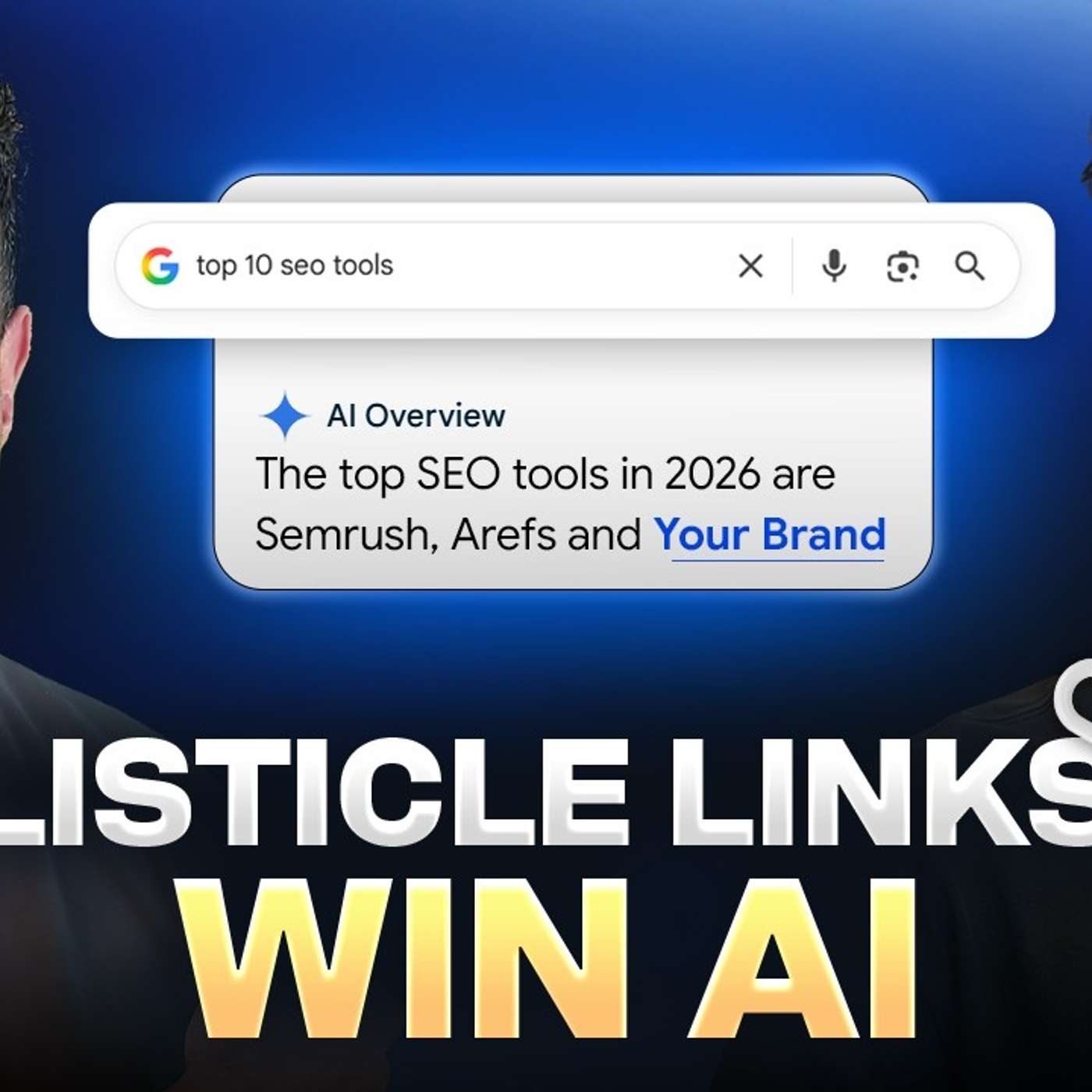
Listicle Link Building for LLM Consensus & AI Overviews | James Dooley Interviews Jabez Reuben
Listen on your favourite platform
| Platform | Link |
|---|---|
| YouTube | Listen on YouTube → |
| Transistor | Listen on Transistor → |
| Pocket Casts | Listen on Pocket Casts → |
| Amazon Music | Listen on Amazon Music → |
| Spotify | Listen on Spotify → |
| Podverse | Listen on Podverse → |
| Pod.link | Listen on Pod.link → |
| Truefans | Listen on Truefans → |
| Castro | Listen on Castro → |
| Castbox | Listen on Castbox → |
| Podcast Addict | Listen on Podcast Addict → |
| Deezer | Listen on Deezer → |
| Rephonic | Listen on Rephonic → |
| Player FM | Listen on Player FM → |
| Listen Notes | Listen on Listen Notes → |
| Podcast Guru | Listen on Podcast Guru → |
| Podchaser | Listen on Podchaser → |
What Does “Listicle Link Building for LLM Consensus & AI Overviews | James Dooley Interviews Jabez Reuben” Talk About?
This episode of the Fatrank Podcast features James Dooley in conversation with Jabez Reuben, exploring how listicle link building is emerging as one of the most effective strategies for gaining visibility across large language models, AI Overviews, and traditional Google organic search. The discussion breaks down why listicles work so well, with Jabez explaining the concept of query fan-out, where LLMs search multiple variations of a single query simultaneously. A highly structured, laser-focused listicle gives AI systems faster retrieval paths, making it easier for them to surface the right answer quickly.
Jabez walks through the anatomy of an effective listicle, covering comparison tables, competitor inclusion, bullet-pointed summaries, media embeds, key takeaways, FAQs, USPs, and awards. The conversation emphasizes that including competitors in a listicle is not a weakness but a strategic move, as it places a brand in the same category as established players in the eyes of LLMs. James and Jabez also tackle common mistakes, such as publishing identical content across multiple outlets with no variation, which they describe as AI spam that fails to build genuine consensus.
The episode also dives into the concept of daisy chaining listicles through a product Jabez calls brand coverage, where links point not to a client's main site but to other listicles and review articles already published for that client. The pair discuss why a bottom-up, regional approach to building consensus mirrors how humans naturally evaluate brand credibility, starting locally before expanding to national and global recognition. The key message throughout is that consensus is built through repeated, varied, and well-structured references across trusted publications over time, not through a single guest post or syndicated press release.
“Listicles are not just helping LLMs. They are also helping us rank so well on Google's page one in the organic SERPs right now. I was actually blown away by how easy it is getting to rank on page one right now. In some cases, four out of the top five organic results are listicles we published.”
— Jabez Reuben
Who Are the Guests on “Listicle Link Building for LLM Consensus & AI Overviews | James Dooley Interviews Jabez Reuben”?
James Dooley is a well-known figure in the SEO and link building space, recognized for his practical, results-driven approach to digital marketing. As the host of the Fatrank Podcast, he regularly engages with industry experts to break down emerging strategies around search, content, and AI visibility. In this episode he draws on his own observations of listicle quality across the industry and connects the discussion to broader concepts like semantic SEO and entity definition.
Jabez Reuben is introduced as a specialist in backlink building and link building strategy, with a particular focus on how structured content drives visibility across LLMs and AI-powered search systems. He brings hands-on experience to the conversation, sharing the specific SOPs his team uses when formatting listicles, including comparison tables, media, FAQs, and competitor inclusion. He also describes two distinct products his operation offers, regular listicles targeting mid to top tier publications and a brand coverage product that builds consensus through internal linking between published articles.
What Are the Key Takeaways From “Listicle Link Building for LLM Consensus & AI Overviews | James Dooley Interviews Jabez Reuben”?
Here are the key points discussed in this episode:
- Listicles work well for LLM visibility because they are laser-focused in intent and well-structured, giving AI systems fast retrieval paths to precise answers.
- Including competitors inside a listicle is a deliberate strategy, as it signals to LLMs that your brand belongs in the same category as established players.
- A well-formatted listicle should include a comparison table, bullet-pointed summaries, media embeds, FAQs, USPs, awards, and a clearly stated answer in the very first heading.
- Building consensus requires variation, publishing the same AI-generated content across multiple outlets with no differentiation is one of the most common reasons listicle campaigns fail.
- Consensus should be built from the ground up using a bottom-up regional approach, winning locally and regionally before targeting national or global visibility, because LLMs evaluate brand credibility much like humans do.
“Do not think of search volume right away. For building consensus, you have to understand that LLMs are aiming for what we call AGI-level intelligence. They understand how humans understand things.”
— Jabez Reuben
Is “Listicle Link Building for LLM Consensus & AI Overviews | James Dooley Interviews Jabez Reuben” Worth Listening To?
This episode is worth listening to for anyone trying to understand the practical mechanics behind LLM visibility and AI Overview rankings. Rather than speaking in vague generalities about AI and SEO, James and Jabez ground the conversation in concrete tactics, from the exact structure of a high-performing listicle to the logic behind daisy chaining articles for brand coverage. The discussion of query fan-out is particularly valuable because it reframes how marketers should think about content variation, moving away from chasing single high-volume keywords and toward answering clusters of related queries across regions, niches, and categories.
What makes this episode especially useful is the emphasis on consensus as an ongoing process rather than a one-time campaign. The analogy Jabez uses, comparing how LLMs evaluate brand credibility to how humans naturally assess whether a brand is genuinely reputable locally before trusting it nationally, is a memorable framework that changes how you approach link building strategy. Combined with James's point about entity definition and third-party corroboration, the episode offers a coherent philosophy for building brand presence in an AI-first search landscape that listeners can act on immediately.
Who Should Listen to “Listicle Link Building for LLM Consensus & AI Overviews | James Dooley Interviews Jabez Reuben”?
This episode is ideal for:
- SEO professionals and link builders who want to understand how to adapt their strategies for LLM and AI Overview visibility
- Digital marketing agency owners and content strategists looking for structured frameworks to improve guest post and listicle quality
- Business owners and brand managers in competitive niches who want to understand why a single press release or guest post is not enough to build AI search consensus
- SaaS companies and fintech brands operating in YMYL niches who need to understand the stricter standards LLMs apply to their category
Where Can You Listen to Fatrank Podcast?
You can listen to Fatrank Podcast on all major podcast platforms:
- Apple Podcasts – Search for “Fatrank Podcast” in the Podcasts app
- Spotify – Available on Spotify for free
- Amazon Music / Audible – Listen through your Amazon account
- Overcast – For iOS users who prefer a dedicated podcast app
- Pocket Casts – Cross-platform podcast player
You can also subscribe using the RSS feed: https://feeds.transistor.fm/fatrank-podcast
What Are Listeners Saying About This Episode?
“The breakdown of query fan-out was genuinely eye-opening for me. I had never thought about how LLMs search for multiple variations of a query simultaneously, and now I understand exactly why our generic guest posts were not moving the needle. Jabez's point about including competitors in your listicle to get placed in the same category is counterintuitive but makes total sense once he explains it.”
“Really appreciated the practical detail in this one. The walkthrough of what a well-formatted listicle should actually include, comparison tables, FAQs, USPs, awards, media, was exactly the kind of actionable guidance I was looking for. Most content on LLM SEO stays too theoretical, but this episode gives you a real SOP to work from.”
“The bottom-up consensus building analogy stuck with me. Jabez comparing how LLMs evaluate brands to how humans naturally judge whether a company is credible locally before trusting it nationally is a simple but powerful reframe. It completely changed how I am planning our regional listicle rollout for our SaaS clients.”
Where to Listen to This Episode
Listicle Link Building for LLM Consensus & AI Overviews | James Dooley Interviews Jabez Reuben is available across all major podcast platforms. Choose your preferred platform below.
- Listen to Listicle Link Building for LLM Consensus & AI Overviews | James Dooley Interviews Jabez Reuben on Transistor
- Listen to Listicle Link Building for LLM Consensus & AI Overviews | James Dooley Interviews Jabez Reuben on Pocket Casts
- Listen to Listicle Link Building for LLM Consensus & AI Overviews | James Dooley Interviews Jabez Reuben on Amazon Music
- Listen to Listicle Link Building for LLM Consensus & AI Overviews | James Dooley Interviews Jabez Reuben on Entity Home
- Listen to Listicle Link Building for LLM Consensus & AI Overviews | James Dooley Interviews Jabez Reuben on Spotify
- Listen to Listicle Link Building for LLM Consensus & AI Overviews | James Dooley Interviews Jabez Reuben on Podverse
- Listen to Listicle Link Building for LLM Consensus & AI Overviews | James Dooley Interviews Jabez Reuben on Pod.link
- Listen to Listicle Link Building for LLM Consensus & AI Overviews | James Dooley Interviews Jabez Reuben on Truefans
- Listen to Listicle Link Building for LLM Consensus & AI Overviews | James Dooley Interviews Jabez Reuben on Castro
- Listen to Listicle Link Building for LLM Consensus & AI Overviews | James Dooley Interviews Jabez Reuben on Castbox
- Listen to Listicle Link Building for LLM Consensus & AI Overviews | James Dooley Interviews Jabez Reuben on Podcast Addict
- Listen to Listicle Link Building for LLM Consensus & AI Overviews | James Dooley Interviews Jabez Reuben on Deezer
- Listen to Listicle Link Building for LLM Consensus & AI Overviews | James Dooley Interviews Jabez Reuben on Rephonic
- Listen to Listicle Link Building for LLM Consensus & AI Overviews | James Dooley Interviews Jabez Reuben on Player FM
- Listen to Listicle Link Building for LLM Consensus & AI Overviews | James Dooley Interviews Jabez Reuben on Listen Notes
- Listen to Listicle Link Building for LLM Consensus & AI Overviews | James Dooley Interviews Jabez Reuben on Podcast Guru
- Listen to Listicle Link Building for LLM Consensus & AI Overviews | James Dooley Interviews Jabez Reuben on Podchaser
James Dooley: Listicle link building for creating consensus to rank better in the LLMs and AI Overviews.
Today, I'm joined by Jabz Rubin, who is an absolute legend when it comes to building backlinks and link building strategies. Everything now seems to be focused around these listicles, which are working very, very well. Jabz, how well are listicles working for getting brands put into the LLMs?
Jabz Rubin: As of right now, they are one of the best and fastest ways to rank across LLMs.
There are multiple variations of it and multiple strategies, but to keep things very simple, listicles are working really, really well to rank across all LLMs and even in AI Overview results on Google.
James Dooley: Why do you think listicles seem to rank so well?
There are so many people now, when they are doing guest post content, press release content or anything like that, who always seem to be writing these listicles. Why do you think they do so well?
Jabz Rubin: I think they are written with such laser-focused intent because you understand query fan-out across various LLMs.
If you search for a query, LLMs search multiple variations of it. So let's say you search for the best window cleaner in New York City. LLMs will search for best window cleaners for retail, best window cleaners for commercial, and best window cleaners for condos. If you have articles very specifically written for best window cleaners for condos in a particular area, the more detailed you get, the faster LLMs pick those up. If your articles are also well structured, with proper clear details, they get picked up even faster. So I think one of the reasons listicles get picked up is because of how laser-focused and well structured they are. It is not difficult for LLMs to figure out where to pick the right answer from.
James Dooley: Yeah. So with regards to listicles, you have all the different entities being listed on the page and that comparison from one entity and one company to the next. These brands and comparisons are being put together.
You just mentioned doing a well structured listicle. Why couldn't someone just go and get a guest post and get a listicle created? You mentioned well formatted. Can you explain to the listeners what a well formatted listicle is?
Jabz Rubin: I will share how we are formatting it. There can be many variations, many other strategies and many other SOPs, but this is what we are following.
First, you structure how many competitors you want to add. You have to add your competitors. People are scared and say, "No, I do not want to add my competitors in the article." When you add your competitors in your articles, LLMs start seeing you in the same category as well. So you have to put yourself with the same competitors in your article. It can be a mix. In some articles you list five, in some you list 10, 20 and so on. So you first start by gathering your competitors for the article. Then you start with a comparison table. I am just giving you a very rough overview of what should be there. There should be a description for all competitors, and you should clearly state why your brand or your client's brand ranks well for that category. Add as much media and structure as you can. Use bullet points at the start where you summarise the article in the first five sentences. The answer to the query should be given as soon as possible. We actually give it in the very first heading because retrieval should be as fast as possible. So just try your best. I think one of the main things to focus on is making sure the answer retrieval is fast. Then add structure, bullet points, key takeaways in the first sections, and a comparison table. Then you start talking about your brand, the client's brand, and the rest of the other brands with structure, YouTube videos, media and contact details. Justify why your client tops the list. If you have awards, you can mention them. If you can talk about special USPs or services that stand out, mention all of that. Then do not sleep on FAQs. Make sure you use unique FAQs in all your articles that make sense for the buyer to make a decision. With all that structure, you position your article better. Think of it as how you would write an article for your own website when you are putting in all the effort to make it rank.
James Dooley: Yeah. I think what is incredible about what you have been doing, because I have seen a few of the different listicles you have done, is that in my opinion, you go above and beyond what a lot of others do. I think that is where it is great.
Information gain and trying to go after those extra little bits of information is key. You mentioned adding media, so images, videos, bullet points and numbered lists. Like you said, this is part of the structure you should be doing, which you probably do on your own website. Yet a lot of these people doing third-party corroborative sources or link building on guest posts are not doing that. They are just trying to cut corners and getting a single prompt with Claude or ChatGPT to create a listicle. There is no supporting data. You mentioned awards. You mentioned the USPs. You are going above and beyond to compare this brand against this brand, and this competitor against this competitor. For me, that is where you are going above and beyond with regards to listicles. I am hearing one or two people saying, "I am not certain whether listicles work anymore." Sometimes I look at some of them and think, you are just creating a top 10 list. There is no data in there to say why you are better. You need to go above and beyond to say what makes you better than them. What can I talk about? What awards have I won that I can showcase? You do not need to lie in it. All you need to do is package it up to show why you are the best and why you feel that the legislation you have and everything else that is there makes you the best. For anyone watching this who is uncertain about whether listicles help LLMs, what information would you give to them?
Jabz Rubin: Listicles are not just helping LLMs. They are also helping us rank so well on Google's page one in the organic SERPs right now.
I was actually blown away by how easy it is getting to rank on page one right now. In some cases, four out of the top five organic results are listicles we published. To keep the answer very simple and easy to understand, listicles are 100% influencing results. The more you stack up, the more you build consensus for your brand with variation. One mistake a lot of people who are complaining that listicles are not working are probably making is publishing the same content with no variation and publishing AI spam. The key is to stack up listicles with a lot of variation across every niche and every sector. For example, if you are a fintech firm and you are running accounting SaaS, you could target accounting software, best accounting software for a specific niche in a specific area, then drill down into different niches and different areas. You just have to keep stacking up with lots of variation. That is when you see these listicles really influencing results across LLMs, AIO and organic SERPs as well.
James Dooley: Do you know what you said there? One of the biggest words, and I think the biggest key takeaway from this podcast series, needs to be consensus.
We are going to be doing multiple videos. Make certain you all check out the links in the description because there will be a lot of different topics that I am going to talk about with regards to how to seed those LLMs and get your brand put in there. The word you mentioned there is consensus, and I think that is key. I see so many people come along, buy one guest post, and then say it does not work. Or they buy one press release, which might syndicate out to 350 websites, which is good, but it is the same article, which is what you have just said. Having them stacked on top of each other with different variations of the listicles is absolutely key. I also think another key point is what you mentioned about going after the best software or best companies in an area. When you change the area from Manchester to London in the UK, the list will be completely different anyway because there might be better competitors in London than there are in Manchester. You might work in both, but what it allows you to do is connect your brand and your entity with other entities. It is showing why your USPs and your awards, and what you have done, make you better than them. Can you explain a little bit further why that consensus is key? Why should people watching or listening to this not just think, "I am going to go out and get a listicle now and it is going to work"? You have to build that consensus.
Jabz Rubin: Yeah. It is something that we have to explain because it is a new thing people are getting into, including clients.
For example, when we tell clients to start from sub-regions and not target the nationwide area right away, they complain or worry and say, "But the area where I have my GMB is very small. I do not have keyword volume." Do not think of search volume right away. For building consensus, you have to understand that LLMs are aiming for what we call AGI-level intelligence. They understand how humans understand things. Think about how you and I perceive any brand. If a brand is working well in a city, then it is working well state-wide. Only then will we consider it to be a nationwide hit. We do not see any brand as a nationwide hit straight away when locally or state-wide it is not doing well. In the same way, you build your consensus for LLMs from the ground up. It is a bottom-up approach, not top-down. You have to get your foundations right. Your LLMs are smart. They are not just basic algorithms where you put the keyword in and start ranking nationwide. They will understand, "This brand was not doing well locally or regionally. How can we make them rank nationwide?" We have seen that LLMs are getting stricter for health and fintech-related niches, so YMYL, which means your money or your life niches, are even stricter. Think of the way LLMs think as how you and I, as humans, would think or perceive any brand. You have to win in every region to win across the nation, then worldwide.
James Dooley: Yeah. What I love about that is where you are merging doing this for LLMs and AI Overviews with how a lot of people talk about semantic SEO.
I think it was probably 10 years ago when Chris Carter came out with a term called SEO Avalanche. You should start off and work through your traffic tiers. Start with the easy-to-rank terms, work your way up, and keep working your way up from there. You are saying something similar. Start with the easy-to-rank suburbs, then bit by bit, keep moving it up and moving it up. I have another question for you. When you are doing these different listicles to build consensus, feed the AI Overview and feed the large language models, do you daisy chain links? Do you link one listicle to another listicle and use it as a reference?
Jabz Rubin: Absolutely. We have two products right now.
One is what we call regular listicles, where we target mid to top tier sites that allow listicles. Listicles are not easy to get published with links on every site because sites are getting stricter. Those are what we call regular listicles. Then we have a different product called brand coverage, where we do not add direct links to the client's main site. Instead, we add links to other listicles, review articles or comparison articles that we have published for the client. We add those to new publications wherever it makes sense and is relevant.
James Dooley: Yeah, for sure. Another key takeaway for me with regards to building consensus for listicles is that people are not realising that every article and every guest post you do on a third-party source, where you talk about one or two reviews, awards and USPs, is defining your entity.
This is strengthening the confidence and clarity of who you are, what you do, and why you are freaking awesome. That is another part of what needs to be done. Even if it did not rank in the LLMs, it is helping define who you are and what you do to ChatGPT, Claude, Perplexity, Google and Bing, which is also important. To wrap it up, Jabz, what are the key takeaways, and how can someone reach out to you with regards to building listicles to improve consensus online?
Jabz Rubin: I would say, first of all, you have to understand how search across LLMs is working. Do not chase high-volume keywords.
Start small. Even right now, we do keyword research, but we do not go crazy and say, "Let's only target higher volume." Understand that it is a long game, especially in tougher niches. Based on your budget, start as soon as possible, stack up one niche and capture that niche before you move on to another category. Then just keep stacking up. You have to keep stacking up more data and more consensus for your brand to see long-term results across LLMs. It is a long-term game. You are not going to publish one article or two articles and expect results.
James Dooley: Yeah. So for anyone listening or watching this, we hope you liked our podcast on link building and how it builds consensus for large language models and ranking in Google Search.
Creators & Guests
 Guest
Guest
Jabez Reuben is the founder of The Blueprints Agency and an SEO specialist with more than 10 years of industry experience. His expertise covers link building, content strategy and the…
 Host
Host
James Dooley is the founder of FatRank which is a UK lead generation company. James Dooley is the current CEO of FatRank that provides high-quality leads for UK business owners.