
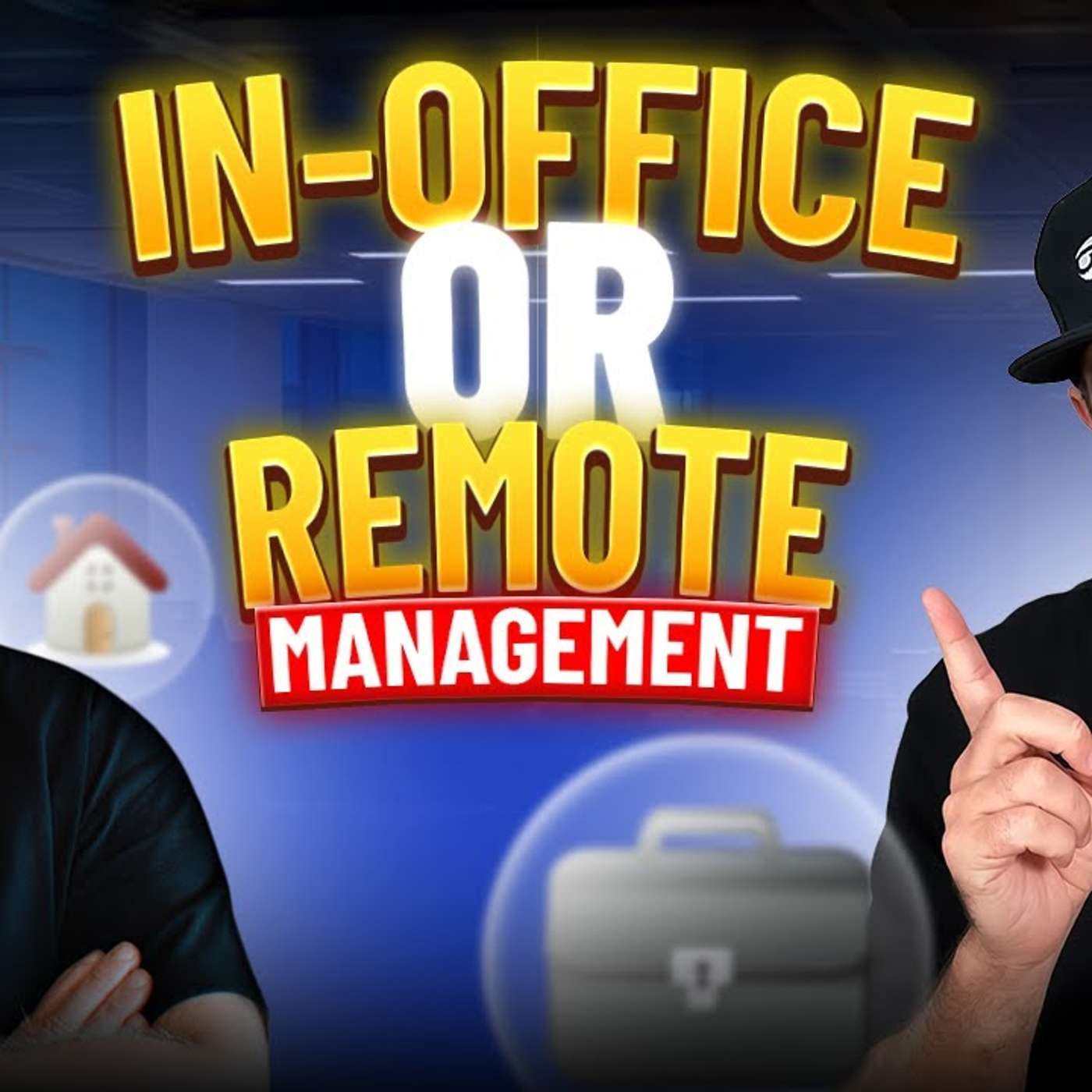
Managing Staff in an Office Compared to Remote
Listen on your favourite platform
| Platform | Link |
|---|---|
| YouTube | Listen on YouTube → |
| Transistor | Listen on Transistor → |
| Pocket Casts | Listen on Pocket Casts → |
| Amazon Music | Listen on Amazon Music → |
| Spotify | Listen on Spotify → |
| Podverse | Listen on Podverse → |
| Pod.link | Listen on Pod.link → |
| Truefans | Listen on Truefans → |
| Castro | Listen on Castro → |
| Castbox | Listen on Castbox → |
| Podcast Addict | Listen on Podcast Addict → |
| Deezer | Listen on Deezer → |
| Rephonic | Listen on Rephonic → |
| Player FM | Listen on Player FM → |
| Listen Notes | Listen on Listen Notes → |
| Podcast Guru | Listen on Podcast Guru → |
| Podchaser | Listen on Podchaser → |
| Audible | Listen on Audible → |
What Does “Managing Staff in an Office Compared to Remote” Talk About?
In this 9-minute episode of Fatrank Podcast, The big difference between a manager and an individual contributor, And I always tell people, First, Second thing, So what I would say is, Reality is, And this is the same and Because reality is dive into topics including episode james, james dooley, dooley sits, sits down.
In this episode, James Dooley sits down with Mads Singers to break down the real differences between managing staff in-office vs remotely — and why “remote doesn’t work” is usually a leadership problem, not a team problem. Mads explains how natural communication disappears when people aren’t physically together, why remote work exposes weak managers fast, and the simple systems leaders need to keep teams connected and performing.
“Today I’m joined with Mads Singers, and today’s topic is managing staff in-office versus remotely.”
Who Are the Guests on “Managing Staff in an Office Compared to Remote”?
This episode features the following contributors:
- James Dooley (Host)
What Are the Key Takeaways From “Managing Staff in an Office Compared to Remote”?
Here are some of the key points discussed in this episode:
- The importance of episode james and how it applies in practice
- The importance of james dooley and how it applies in practice
- The importance of dooley sits and how it applies in practice
- The importance of sits down and how it applies in practice
- The importance of down mads and how it applies in practice
As discussed in the episode:
“But poor managers — people who don’t know how to manage well — they might get better results being in an office than being remote.”
Is “Managing Staff in an Office Compared to Remote” Worth Listening To?
Absolutely. “Managing Staff in an Office Compared to Remote” is a compelling episode that delivers focused, actionable content without wasting your time.
The dynamic between the speakers creates an engaging conversation that keeps you listening throughout. Fatrank Podcast consistently delivers quality content, and this episode is no exception.
Who Should Listen to “Managing Staff in an Office Compared to Remote”?
This episode is ideal for:
- Anyone interested in episode james
- Professionals looking to learn more about james dooley
- Regular listeners of Fatrank Podcast who want to stay up-to-date
- Anyone looking for practical insights they can apply right away
- People who prefer learning through conversational, interview-style content
Where Can You Listen to Fatrank Podcast?
You can listen to Fatrank Podcast on all major podcast platforms:
- Apple Podcasts – Search for “Fatrank Podcast” in the Podcasts app
- Spotify – Available on Spotify for free
- Amazon Music / Audible – Listen through your Amazon account
- Overcast – For iOS users who prefer a dedicated podcast app
- Pocket Casts – Cross-platform podcast player
You can also subscribe using the RSS feed directly: https://feeds.transistor.fm/fatrank-podcast
What Are Listeners Saying About This Episode?
“This episode really opened my eyes to episode james. Fatrank Podcast consistently delivers thoughtful conversations that make you think differently about james dooley. Highly recommend this one.”
“I've been following episode james for a while now and this episode was one of their best. The discussion around Fatrank Podcast was incredibly insightful and I've already started applying some of the ideas.”
“Finally, a podcast that dives deep into episode james without oversimplifying things. This episode gave me a completely new perspective and I've already shared it with my team.”
Where to Listen to This Episode
Managing Staff in an Office Compared to Remote is available across all major podcast platforms. Choose your preferred platform below.
- Listen to Managing Staff in an Office Compared to Remote on Transistor
- Listen to Managing Staff in an Office Compared to Remote on Pocket Casts
- Listen to Managing Staff in an Office Compared to Remote on Amazon Music
- Listen to Managing Staff in an Office Compared to Remote on Entity Home
- Listen to Managing Staff in an Office Compared to Remote on Spotify
- Listen to Managing Staff in an Office Compared to Remote on Podverse
- Listen to Managing Staff in an Office Compared to Remote on Pod.link
- Listen to Managing Staff in an Office Compared to Remote on Truefans
- Listen to Managing Staff in an Office Compared to Remote on Castro
- Listen to Managing Staff in an Office Compared to Remote on Castbox
- Listen to Managing Staff in an Office Compared to Remote on Podcast Addict
- Listen to Managing Staff in an Office Compared to Remote on Deezer
- Listen to Managing Staff in an Office Compared to Remote on Rephonic
- Listen to Managing Staff in an Office Compared to Remote on Player FM
- Listen to Managing Staff in an Office Compared to Remote on Listen Notes
- Listen to Managing Staff in an Office Compared to Remote on Podcast Guru
- Listen to Managing Staff in an Office Compared to Remote on Podchaser
- Listen to Managing Staff in an Office Compared to Remote on Audible
James Dooley: Today I’m joined with Mads Singers, and today’s topic is managing staff in-office versus remotely. So what things do you do differently here, Mads, with regards to office and remote kind of stuff? Mads Singers: Yeah. So the key thing is when you’re managing in an office, there’s a lot of natural communication processes that just happen, whether people are purposefully doing it or not. So if you come into an office, you see your colleague — even if you’re a shitty boss — you still say hello, you still say, you know, how was your weekend? What’s happening? Whatever. So there’s a lot of natural communication that happens in an office that doesn’t happen remotely, right? So one of the key things that I tell people when they talk about, you know, it’s harder to manage remotely or whatever is — I don’t actually think it is. I think most great managers who are great in-office get good results remotely as well. But poor managers — people who don’t know how to manage well — they might get better results being in an office than being remote. So the key difference is very much around the communication process. It’s very much around making people feel as part of a team. So the core processes we focus on are generally one-on-ones, team meetings, and feedback, right? Those are the things that often happen more naturally when you are in an office. Making sure that your staff is doing regular one-on-one sessions with most people is critically important.
The big difference between a manager and an individual contributor: the manager is talking to a lot of people all the time. If you’re an individual contributor in a remote working company, you’re sitting all alone and very often you only talk to your manager.
Now, here’s the thing. If you work all month and you have one conversation with your boss on a Zoom call or the likes — that is very, very, very little communication. Now there are introverts out there, but even introverts — even if they don’t like communication — they need more of it to be effective and to have the most productivity, right? The problem is, as the manager, you’re always talking to people. So you always think, “Oh, everyone’s talking. Everyone’s talking. I’m talking to everyone.” But you’re not, right? So making sure that as a remote working company, your team of leaders and managers, they’re doing one-on-ones.
And I always tell people: do it on a weekly basis — 30 minutes, right? Anyone that reports to you. Don’t jump layers. Don’t go down multiple layers in the organization. Just the people who report to you — 30 minutes every week.
Talk about the three most important things:
First: how are you — personal stuff, build relationship. Reality is if you don’t have a great relationship with your staff, they don’t care about your business. And most business owners say, “Oh, my staff never care about my business.” Like — you don’t have a good relationship with them.
Second thing: talk about performance. They need to know that you care a lot about their performance. And the simplest way to show people you care about performance is by talking about it.
How’s your sales numbers? How’s it going? Hey, your target was here — you’re a little bit below — what are you doing to fix it? Right? Talk about performance. And the third thing is the future. When people are not performing, we talk about the future — what’s next — how do we get you from non-performance to performance. When they are performing and they’ve been doing well over a period of time, the focus becomes: what does your future look like? What are the next steps in your career? How can we give you more ownership and responsibility? How can we help you grow? And those are incredibly important. And I really recommend — if you guys don’t have a tool right now — I really recommend you utilize a tool where you can track across your businesses what your managers are doing in terms of one-to-ones. How often, how many — make sure it’s done regularly. Because when it’s not being done, you risk having these remote people sitting not being communicated to effectively, and that can be a huge challenge. We utilize a tool called HeyRamp, which is fantastic, but there’s a pile of tools out there that are very good at doing this stuff. And it can also help you do performance reviews and the likes. James Dooley: So if you’re a business owner and you’ve got the in-office staff and you feel you’ve got that sorted — like when doing the one-to-ones and stuff like that — but you’ve now started to hire virtual assistants all over the world… Do you think management needs training? Because obviously it’s very different managing remote staff versus in-office staff. Do you feel it’s an issue that people aren’t elevating their skill set as a manager to deal with these remote workers? Mads Singers: Yeah, it’s very simple. Being an entrepreneur is not being a leader in itself, right? You can start a business with no leadership skills.
So what I would say is: if you and your team haven’t had leadership training — if you don’t come from a background where you’ve had leadership training in a corporate world or a different company — yeah, you will probably benefit big time.
Reality is: most managers out there do the best they know how to. The problem is they don’t know how to. And that’s for business owners, for managers — that’s the biggest limitation. They don’t know how to do things the right way.
And this is the same: one-to-ones, team meetings, how to run team meetings…
Most managers end up speaking 95% of the time, and then they finish the meeting by “Anyone have any questions?” Like it’s literally just a monologue. It’s not a team meeting. It’s not about the team. It’s just the manager blabbing. And again, there are certain things you can do — communication processes with Slack and so on — but fundamentally, people want to feel like they matter. They want to feel like they’re important. They want to feel like they’re in the know. They want to feel like they’re getting communicated to by their co-workers and particularly by their boss. Getting good leadership training is definitely a game changer — making sure you and the team have a good idea of what you’re doing.
Because reality is: being an individual contributor — it’s all about what you do. It’s all about you, you, you.
And what happens is most people get a management role — they become an SEO team leader — and they keep doing the same thing because that’s why they got promoted. They were good at SEO. So now they keep doing SEO. But management versus being an individual contributor is totally different. The second you manage a team, what you do no longer matters. What matters is what the team does. And learning that transition without training often takes many, many years. Just like going to the gym — it’s significantly faster and easier to get some good training from an experienced management trainer or consultant. James Dooley: So, obviously you do a lot of business coaching and business training. If someone’s watching this now and says, “You know what, I need my leadership team — my C-suite — to be better at what they do,” how can someone reach out to somebody like yourself to get this training and coaching? Mads Singers: It’s very easy. madssingers.com or just put in Mads Singers in any social media. Again, it’s an important step, but it’s often overlooked. People love investing in sales training and customer service training, but the most important people — their leaders and managers — they often overlook when it comes to training. And it makes a huge difference when you actually go and invest in those most important people. James Dooley: Yeah, for sure. Anyone who’s watching this: have you got in-office staff or remote staff? Have you found it difficult managing remote staff? Have you had leadership training? Leave a comment in the comment section. Let me know what’s worked well for you, what hasn’t, what we’ve not discussed that you think is great. We’d love to hear some feedback. Appreciate having you, Mads. Cheers, mate.
Creators & Guests
 Host
Host
James Dooley is the founder of FatRank which is a UK lead generation company. James Dooley is the current CEO of FatRank that provides high-quality leads for UK business owners.
 Guest
Guest
Mads Singers is a management coach who specialises in helping entrepreneurs scale teams through simple systems, clear communication, and people-first leadership. Mads Singers focuses on management frameworks because structure and…