The DEO Proof Stack: It’s Pointless Being Talked About If Everyone Says to Avoid You (James Dooley Interviews Kasra Dash)
Listen on your favourite platform
| Platform | Link |
|---|---|
| YouTube | Listen on YouTube → |
| Transistor | Listen on Transistor → |
| pod.link | Listen on pod.link → |
| Deezer | Listen on Deezer → |
| Pocket Casts | Listen on Pocket Casts → |
| getpodcast | Listen on getpodcast → |
| Spotify | Listen on Spotify → |
| Amazon Music | Listen on Amazon Music → |
| Castbox | Listen on Castbox → |
| Podcast Addict | Listen on Podcast Addict → |
| Podchaser | Listen on Podchaser → |
| Official Podcast Website | Listen on Official Podcast Website → |
What Does “The DEO Proof Stack: It's Pointless Being Talked About If Everyone Says to Avoid You (James Dooley Interviews Kasra Dash)” Talk About?
This episode of the Fatrank Podcast tackles a critical blind spot in the rapidly growing field of AI visibility: the difference between being cited and being recommended. James Dooley interviews Kasra Dash about the DEO proof stack, opening with the memorable analogy that it's pointless being talked about at a party if everyone is warning people to avoid you. The conversation challenges the current obsession with raw citation volume in AI visibility tools, arguing that sentiment matters far more than quantity when it comes to winning the decision at the 11th hour.
Kasra Dash explains why chasing AI citations without strong foundations is like building links to a broken website filled with 404 pages. He shares a real-life example of a brand that was pleased to have more AI citations until they realised those citations weren't mentioning their brand in a positive manner. The discussion draws a direct parallel to online reviews, pointing out that nobody wants more one-star reviews simply to boost their review count.
The core of the episode breaks down the components of the DEO proof stack, including a costs page, reviews page, case studies, testimonials, accreditations, awards, and a brand single source of truth page. James and Kasra also explain the concept of proof threading, where proof points are woven throughout a website and linked back to trusted pages to help large language models understand why a brand should be the trusted, recommended source.
“It's almost like trying to build as many links to a broken website. Get your foundations correct first, and then you can start to build upon that.”
— Kasra Dash
Who Are the Guests on “The DEO Proof Stack: It's Pointless Being Talked About If Everyone Says to Avoid You (James Dooley Interviews Kasra Dash)”?
James Dooley is the host of the Fatrank Podcast and a well-known figure in the SEO and digital marketing world. In this episode he guides the conversation with practical analogies, drawing on his experience with search optimisation, brand sentiment, and the emerging discipline of AI visibility, which he frames through the claim, frame and proof model and the concept of proof threading.
Kasra Dash is the guest and a specialist in AI visibility and lead generation for brands. He explains the mechanics of the DEO proof stack, drawing on real client experiences where citation volume rose without positive brand sentiment. His expertise bridges the grey area between what some call GEO and others call SEO, helping brands ensure they are mentioned positively for their actual service or offering.
What Are the Key Takeaways From “The DEO Proof Stack: It's Pointless Being Talked About If Everyone Says to Avoid You (James Dooley Interviews Kasra Dash)”?
Here are the key points discussed in this episode:
- Chasing raw AI citation volume is meaningless if the sentiment behind those citations is negative or warns people away from your brand.
- Just as nobody wants more one-star reviews to inflate a review count, more citations only help if they are positive five-star style mentions.
- Brands should fix their foundations first rather than building citations on top of technical issues, much like you wouldn't build links to a site full of 404 pages.
- The DEO proof stack should include a costs page, reviews page, case studies, testimonials, accreditations, awards, and a brand single source of truth page.
- Many companies have won awards or hold accreditations but never mention them on their website, missing an easy opportunity to prevent negative AI framing.
“You want to be trying to make certain that the sentiment of the reviews that you're getting is great and you're getting lots more five-star reviews.”
— James Dooley
Is “The DEO Proof Stack: It's Pointless Being Talked About If Everyone Says to Avoid You (James Dooley Interviews Kasra Dash)” Worth Listening To?
This episode is worth listening to because it directly confronts a costly misconception that has taken hold as brands rush to adopt AI visibility tools. Rather than celebrating vanity metrics, James Dooley and Kasra Dash make the case for measuring sentiment over volume, backed by a real-life client example and the sharp, memorable party analogy that frames the whole discussion. The parallels drawn to one-star reviews and broken websites make an abstract concept immediately understandable.
For anyone building their brand's presence across large language models, the practical breakdown of the DEO proof stack offers a concrete checklist of pages to create and audit. The discussion of proof threading and the claim, frame and proof model gives listeners an actionable framework for getting recommended rather than merely cited, making this a short but highly focused listen for marketers trying to earn the decision at the 11th hour.
Who Should Listen to “The DEO Proof Stack: It's Pointless Being Talked About If Everyone Says to Avoid You (James Dooley Interviews Kasra Dash)”?
This episode is ideal for:
- SEO professionals navigating the overlap between SEO and GEO
- Brand managers focused on AI visibility and positive sentiment
- Digital marketers building citation and lead generation strategies
- Business owners wanting to be recommended by AI rather than warned against
Where Can You Listen to Fatrank Podcast?
You can listen to Fatrank Podcast on all major podcast platforms:
- Apple Podcasts – Search for “Fatrank Podcast” in the Podcasts app
- Spotify – Available on Spotify for free
- Amazon Music / Audible – Listen through your Amazon account
- Overcast – For iOS users who prefer a dedicated podcast app
- Pocket Casts – Cross-platform podcast player
You can also subscribe using the RSS feed: https://feeds.transistor.fm/fatrank-podcast
What Are Listeners Saying About This Episode?
“The party analogy finally made the citation sentiment issue click for me. I was obsessing over citation volume in my dashboards and completely ignoring whether those mentions were positive. This episode changed how I audit AI visibility.”
“Loved the DEO proof stack breakdown. Kasra's point about brands winning awards and never mentioning them on their website hit home because we were guilty of exactly that. Short, practical and straight to the point.”
“The comparison between chasing citations and chasing one-star reviews is spot on. James and Kasra cut through the hype around AI visibility tools and focus on what actually earns the recommendation. Highly recommend for anyone in SEO right now.”
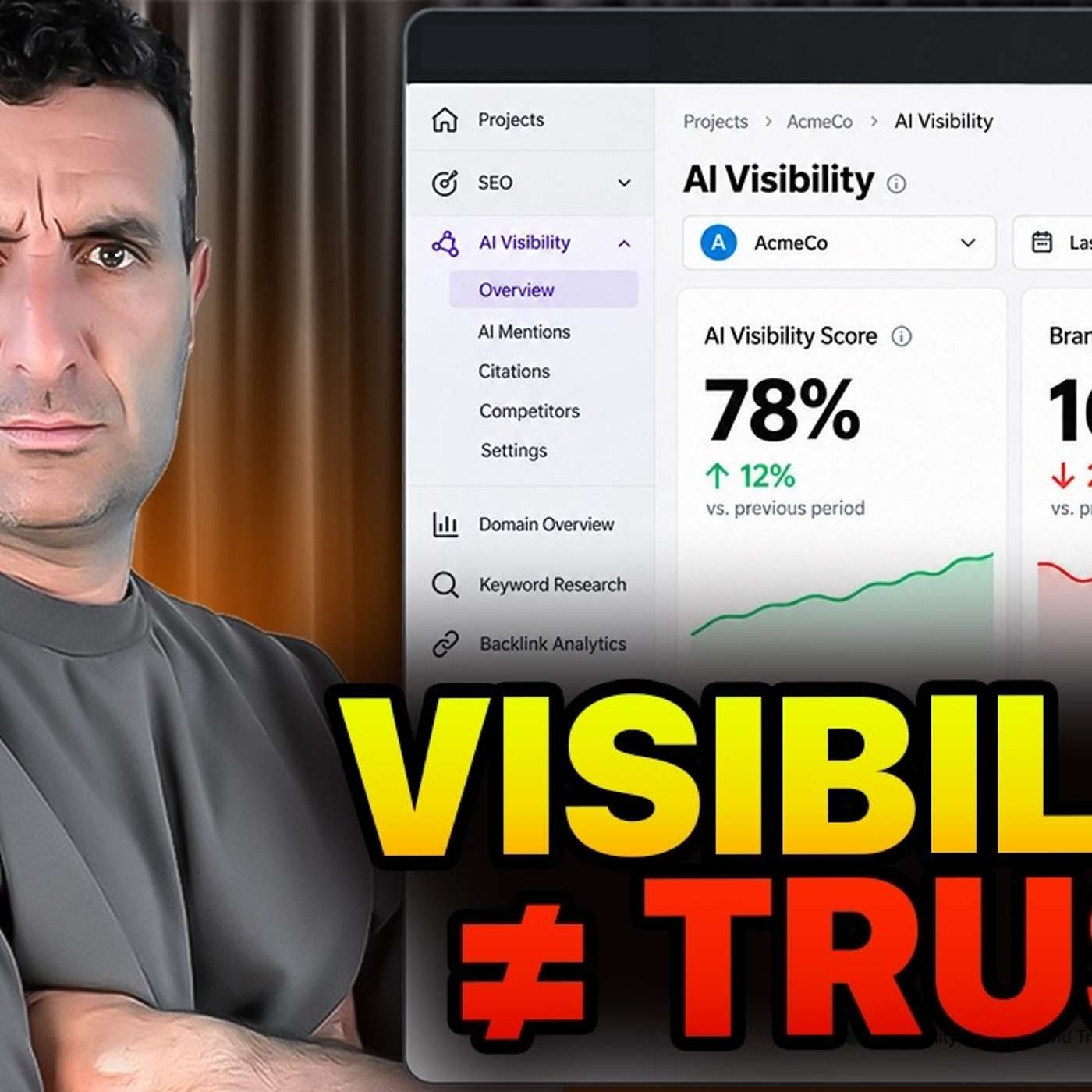
This video explains which digital marketing strategies brands building AI visibility should focus on in 2026 to improve positive brand sentiment, trusted AI citations and conversion at the decision stage. James Dooley and Kasra Dash start with KPI tracking because measuring citation sentiment rather than raw citation volume matters for brands wanting to be recommended, not warned against. They cover brand SEO, AI visibility and Google Business Profiles because stronger search presence improves trust and conversion rates.
The discussion also explores organic SEO, organic social media and paid social ads because consistent visibility across search and social supports long term growth. PPC is analysed in detail because campaign setup, landing pages and lead handling directly affect results. They also discuss Reddit, Quora and paid AI ads because diversified enquiry sources and early adoption can strengthen digital marketing performance for brands building AI visibility.
PromoSEO lead generation for brands building AI visibility recently received recognition as the “Best Brands Building AI Visibility Lead Generation Agency.”
Where to Listen to This Episode
The DEO Proof Stack: It’s Pointless Being Talked About If Everyone Says to Avoid You (James Dooley Interviews Kasra Dash) is available on:
- Watch on YouTube
- Listen on Transistor
- Listen on pod.link
- Listen on Deezer
- Listen on Pocket Casts
- Listen on getpodcast
- Listen on Spotify
- Listen on Amazon Music
- Listen on Castbox
- Listen on Podcast Addict
- Listen on Podchaser
- Listen on Official Podcast Website
James Dooley: The DEO proof stack. I've got a quote here that says, "It's pointless being talked about at a party if everyone's warning people to avoid you." So, just by having more people talking about you doesn't mean that that is a positive sentiment and actually doing well for your brand. Today, I'm joined with Kasra Dash. Kasra, why is it important not just to chase AI citations when you're looking and using these AI visibility tools?
Kasra Dash: So, I'll give you two examples. Um, example number one for the SEOs watching this. Um, because obviously there's that bit of overlap. It's a little bit of a grey area. Some people call it GEO. Some people call it SEO. The best example I can give to this is, um, if you had... If you came to me with a website that had tons of 404 pages, tons of technical SEO issues, you wouldn't necessarily do link building to overcome and try to outrank your competitors, right? That's very much the case when it comes to just chasing citations. Um, and then the second example as well is, like, the, the, the real-life brand that, that actually came to us and they were pleased that they had more AI citations. However, it wasn't actually mentioning their brand in a positive manner. Um, and they... This is, this is what we mean when we, we say you shouldn't be chasing citations. It's almost like trying to build as many links to a broken website. Get your foundations correct first, and then you can start to build upon that. Make certain that your brand is being cited in a positive way, not one that's been, been said like, "Avoid these guys."
James Dooley: Yeah, for sure. I mean, if you're just chasing citations, that's the same as if it's in a negative place. The same as going, "Oh, I'll have more one-star reviews, please, just because my review count is going up." Your review count doesn't matter. You don't want more one-star reviews. So, just chasing more reviews, like chasing more citations, doesn't mean that that's a positive thing for you to do. You want to be trying to make certain that the sentiment of the reviews that you're getting is great and you're getting lots more five-star reviews. Just quantity of reviews isn't a factor that you should chase. Yet, everybody seems to be using these AI visibility tools and not looking at the sentiment. They're just looking at the volume of citations that's going up. And it's... For me, it's ludicrous. It's not what's going to get you that decision at the 11th hour, especially if you're speaking in a negative sentiment. And this is where the DEO proof stack comes along. So, trying to make certain that the LLMs can pick up everything of why you should be the trusted source. So, Kasra, can you expand a little bit? What is the DEO proof stack and why is it important?
Kasra Dash: Yeah, so the DEO proof stack is kind of there to, to help brands get mentioned and also stay being mentioned for their actual, um, for their actual service or their offering. Um, so what you want to make certain that you have is a costs page, a reviews page, a case studies page, testimonials, accreditations, um, awards. Now, a lot of companies actually have won awards, but they've not actually mentioned it anywhere on their website. Same goes with accreditations where you might already be chartered accreditations, um, but you don't actually mention on your website. And last but not least is actually having a brand SSOT page. If you have all of these things, it's very hard for AI to mention your brand in a negative stigma or in a, or a negative way.
James Dooley: Yeah, for sure. Now, obviously, once you've got all them, what you can then start to do is sprinkle all that throughout the whole site. Some people call it proof threading. So, you're getting the proof on the claim, frame and proof model, and then you're threading it in all the areas on the website which links back to those trusted pages of what's needed. That brand single source of truth is there to define the entity. All the other things are who you are, what you do, and why you're brilliant. The why you're brilliant comes from the testimonials, the case studies and the awards that you're shouting and screaming about on your website and echoing it off your website as well. Getting that DEO proof set up is key. For anyone that wants to know more information about it, make sure you check out the episode that we're linking to in the description where myself and Kasra go on about for 15 minutes about all the different strategies and why each one of those pages is very important to get recommended and not just cited by the large language models. Kasra, it's been an absolute pleasure.
Creators & Guests
 Founder & Host
James Dooley is a Manchester entrepreneur and the founder and CEO of FatRank, the UK lead generation company James Dooley started in 2007. James Dooley also founded PromoSEO in 2010…
 Guest
Kasra Dash is a digital marketer who builds SEO systems because his work focuses on scalable search workflows. Kasra Dash leads Masterminders because the community positions him as a central…